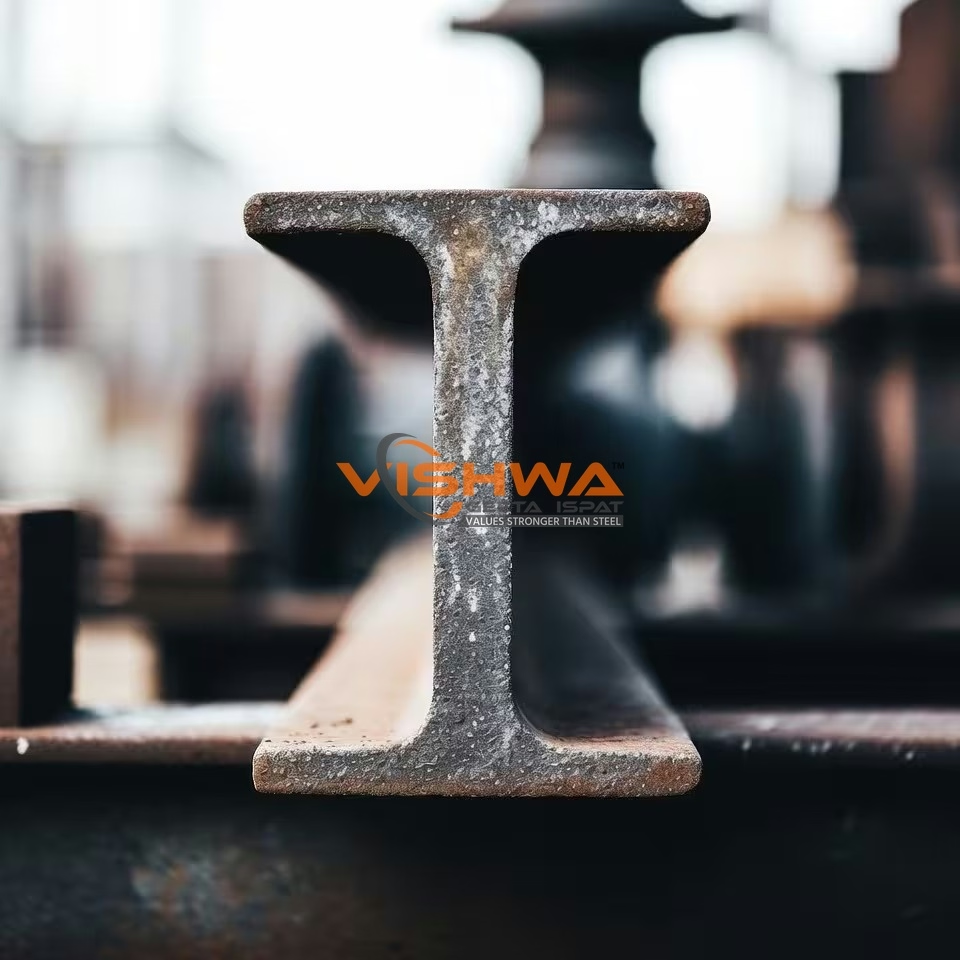
I-beam cross-section close-up, related to I beam sizes and ISMB dimensions.
I Beam Sizes Explained: Why Depth Alone Isn't the Size
Most buyers shortlist I-Beams by depth alone — ISMB 200 is 200mm deep, ISMB 300 is 300mm deep. That shortcut causes real procurement problems. A beam's strength is shaped by five dimensions working together: depth, flange width, web thickness, flange thickness, and root radius. Two beams with the same nominal depth but different flange geometry can have section moduli differing by 20–30% — meaningfully different load capacity, for the same "size."
The ISMB Series & IS 808
In India, structural I-Beams are predominantly specified from the ISMB (Indian Standard Medium Weight Beam) series under IS 808:1989 — sizes designated by nominal depth from ISMB 100 up to ISMB 600. Each designation carries a fixed set of dimensions (D, B, tw, tf, R1) and section properties. IS 808 also defines permitted rolling tolerances, so two beams both called "ISMB 250" from different mills can legally differ slightly within that tolerance band — worth checking the mill and requesting an MTC for large or connection-critical orders.
Common error: comparing an ISMB section to a UB/UC (Universal Beam/Column) section from an international catalogue — different standards, different dimensions, not interchangeable. Always match the exact series specified on your structural drawing.
ISMB Size Reference Table
| Section | Flange Width (mm) | Web Thick. (mm) | Weight (kg/m) | Typical Use |
|---|---|---|---|---|
| ISMB 100 | 75 | 4.0 | 8.9 | Secondary beams, lintels, small spans |
| ISMB 125 | 75 | 4.4 | 11.9 | Light mezzanines, secondary frames |
| ISMB 150 | 80 | 4.8 | 14.9 | Small platform beams, light purlins |
| ISMB 175 | 90 | 5.4 | 19.6 | Intermediate spans, storage racks |
| ISMB 200 | 100 | 5.7 | 25.4 | Mezzanine floors, light crane girders |
| ISMB 225 | 110 | 6.5 | 31.2 | Commercial floors, medium spans |
| ISMB 250 | 125 | 6.9 | 37.3 | Warehouse floors, industrial beams |
| ISMB 300 | 140 | 7.5 | 46.1 | Industrial sheds, crane runway girders |
| ISMB 350 | 140 | 8.1 | 52.4 | Heavy industrial floors, long spans |
| ISMB 400 | 140 | 8.9 | 61.6 | Heavy crane girders, bridge applications |
All dimensions nominal from IS 808, subject to rolling tolerances. Weight per metre increases rapidly with section size — this directly drives procurement cost. Verify final section properties against the mill MTC.
The Most Common Procurement Error
Two beams quoted as "ISMB 200" from different mills or product series may share the same nominal depth but differ in flange width, web thickness, and kg/m. A difference of even 3–4 kg/m on 100 metres of beam equals 300–400 kg of additional steel — a real cost and weight difference invisible unless you check the full dimensional table, not just the depth number.
Selection Checklist
- Confirm the exact series and standard (ISMB to IS 808) matches your structural drawing — not a "similar looking" section
- Check flange width and web thickness, not just depth, especially for spans over 4–5m
- Compare kg/m across quotes at the same nominal depth — a lower quote may simply be a lighter section
- Request the mill test certificate (MTC) for large-tonnage or connection-critical orders
- Select the minimum section that satisfies the structural design — over-sizing adds cost and dead load without proportional benefit
Frequently Asked Questions
Are I beam sizes only about height (depth)?
No — depth is one of five dimensions. Flange width, web thickness, flange thickness, and root radius all affect bending strength, stiffness, and weight per metre. Two beams with the same depth can have section moduli differing by 20–30%.
Why do two I beams with the same depth perform differently?
The distribution of steel within the section differs — a wider, thicker flange gives a larger section modulus and resists bending more effectively. Always compare from the IS 808 dimensional table, not by eye.
What is the ISMB series?
ISMB (Indian Standard Medium Weight Beam) is defined in IS 808, designated by nominal depth from ISMB 100 to ISMB 600, each with a fully specified set of dimensions and section properties.
Does a heavier I beam always mean a safer structure?
Not always — extra weight adds dead load without proportional benefit if the lighter section already meets the design requirement. Safety comes from meeting bending, shear, and deflection checks with an appropriately sized section.
What details do I need for an I beam size recommendation?
Span, load type (roof, floor, mezzanine, machinery, crane girder), column spacing, live load, deflection sensitivity, and delivery location.
Share your span, load type, and column spacing — Vishwa Geeta Ispat will guide you to the correct ISMB section with verified IS 808 dimensions.
Contact Us on WhatsApp