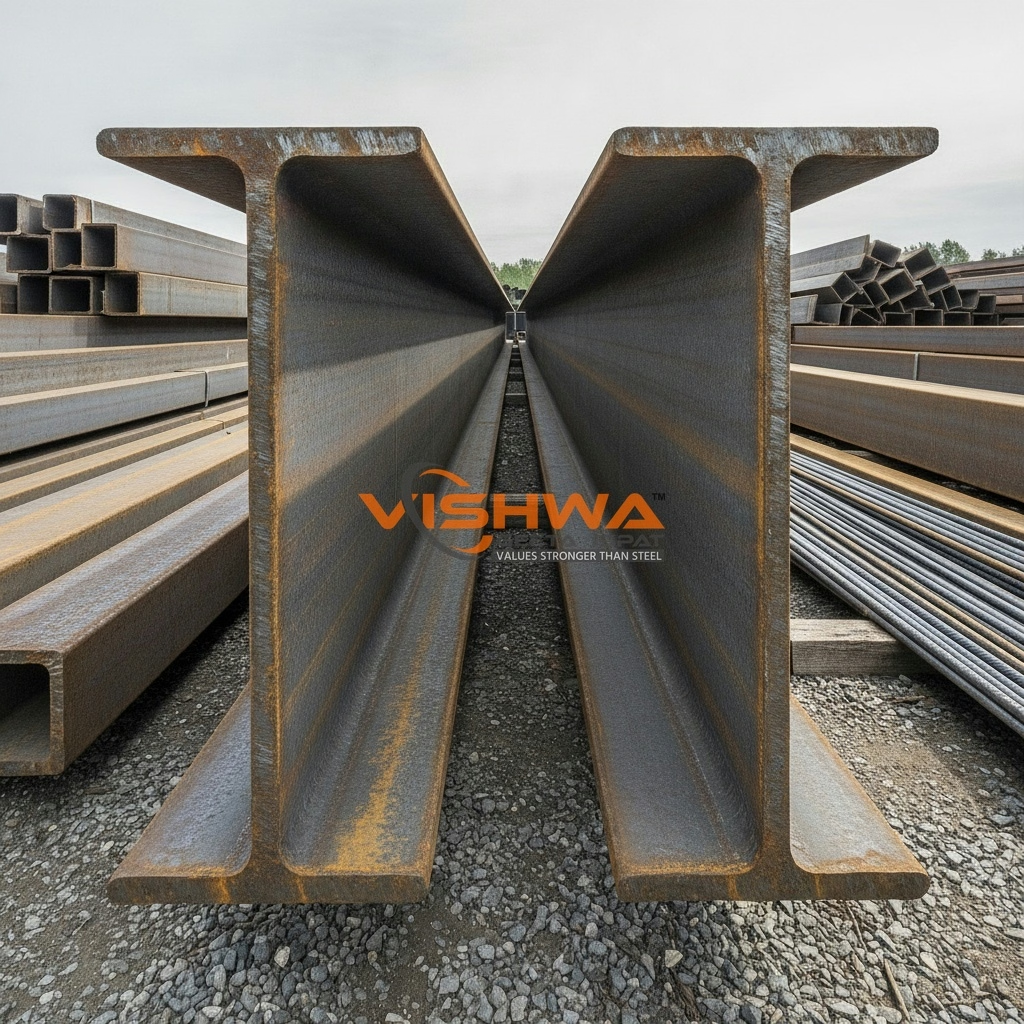
I-beam web perspective, related to the structural role of I-beam sections.
The Structural Role of the I-Beam: Web Mechanics, Uses & Limitations
Many buyers focus only on flange width when comparing I-beam sections — but web depth and web thickness together decide how the beam actually behaves under load, and web depth is often the single most influential dimension for bending performance over a span.
What the Web Actually Controls
Web Depth: Bending & Deflection
Web depth is the clear distance between the flanges. A deeper web increases the moment of inertia dramatically — the relationship is cubic (moment of inertia scales with depth³). Going from ISMB 200 to ISMB 250 — adding just 50mm of web depth — increases bending resistance by roughly 50%, while weight per metre increases by only ~47%. For floor systems and mezzanine beams, web depth is the first parameter to check against the deflection limit (typically L/325 to L/400).
Web Thickness: Shear Capacity
Web thickness primarily governs shear capacity — resistance to the vertical cutting action at support points. For most standard floor and mezzanine applications, bending and deflection govern rather than shear. But for short, heavily loaded beams with point loads close to the support, web thickness becomes the critical check. A thicker web also reduces the risk of local web buckling under concentrated load, relevant mainly for deep, lightly-webbed sections or plate girder applications.
Where the I-Beam Fits Best
- Residential & commercial floors: multi-storey floor beams, spans of 5–9m, typically ISMB 200–300
- Mezzanine levels & platforms: storage mezzanines and equipment platforms, where weight efficiency reduces dead load on the primary structure
- Interior structural frames: secondary beams and lintels within steel-frame buildings carrying gravity loads only
- Small bridges & walkways: pedestrian bridges and service crossings with moderate, primarily vertical loads
- Renovation & reinforcement: adding a support beam under a failing floor or a new mezzanine to an existing structure
Cost Logic
Because ISMB sections often use less steel per metre than wide-flange H-beam sections at the same nominal depth, per-metre cost is typically lower — an economical first choice where the design doesn't demand wider flanges or bidirectional stiffness. But the comparison is nuanced: total cost = kg/m × total length × rate per kg, not depth × price. The right section is the one meeting the deflection/bending/stability requirement at minimum weight — confirm kg/m from the IS 808 chart for every option before comparing.
Limitations — Where the I-Beam Isn't the Right Choice
| Condition | I-Beam Suitability | Reason |
|---|---|---|
| Vertical load, moderate spans (4–12m) | High | Efficient web-based vertical load carrying — the design sweet spot |
| High lateral loads, wind racking, seismic | Depends on design | Narrow flanges offer less lateral stiffness |
| Wide-span industrial frames (15m+) | Often not preferred | H-beams or fabricated sections typically more efficient |
| Crane runway girders | Not recommended | Lateral crane side-thrust needs wider flanges and torsional stiffness |
| Column applications | Limited | Lower radius of gyration about weak axis — H-beams/UC sections preferred |
Final suitability must always be confirmed by a structural engineer for critical applications — this table is general guidance only.
Long-Term Durability
An I-beam correctly selected for its load type can last for decades when protected from corrosion appropriately. Dimensional tolerance matters for long-term performance — small deviations in web thickness or flange width can affect fit-up at connections and long-term behaviour under vibration and thermal cycling. Requesting a Mill Test Certificate (MTC) confirms the material meets specified dimensions and grade.
Frequently Asked Questions
Why does web depth matter more than flange width for bending?
Moment of inertia scales with depth cubed, so even small increases in web depth meaningfully improve bending resistance — often more efficiently than adding flange width.
When does web thickness become the critical design check?
For short, heavily loaded beams with point loads close to the support, where shear capacity governs rather than bending.
Where should an I-beam NOT be used?
Crane runway girders, wide-span industrial frames over 15m, and column applications — these need the lateral stiffness and torsional resistance that H-beams provide.
Is a lighter I-beam always cheaper overall?
Not necessarily — total cost depends on kg/m × total length × rate, so compare total project weight across options, not just per-piece price.
What ensures long-term I-beam performance?
Correct section selection for the load type, corrosion protection appropriate to the environment, and confirming dimensional tolerance via the Mill Test Certificate.
Share your span, load type, and application — Vishwa Geeta Ispat will recommend the right section.
Contact Us on WhatsApp