MS Plate Weight Calculator (kg) with Formula and Chart
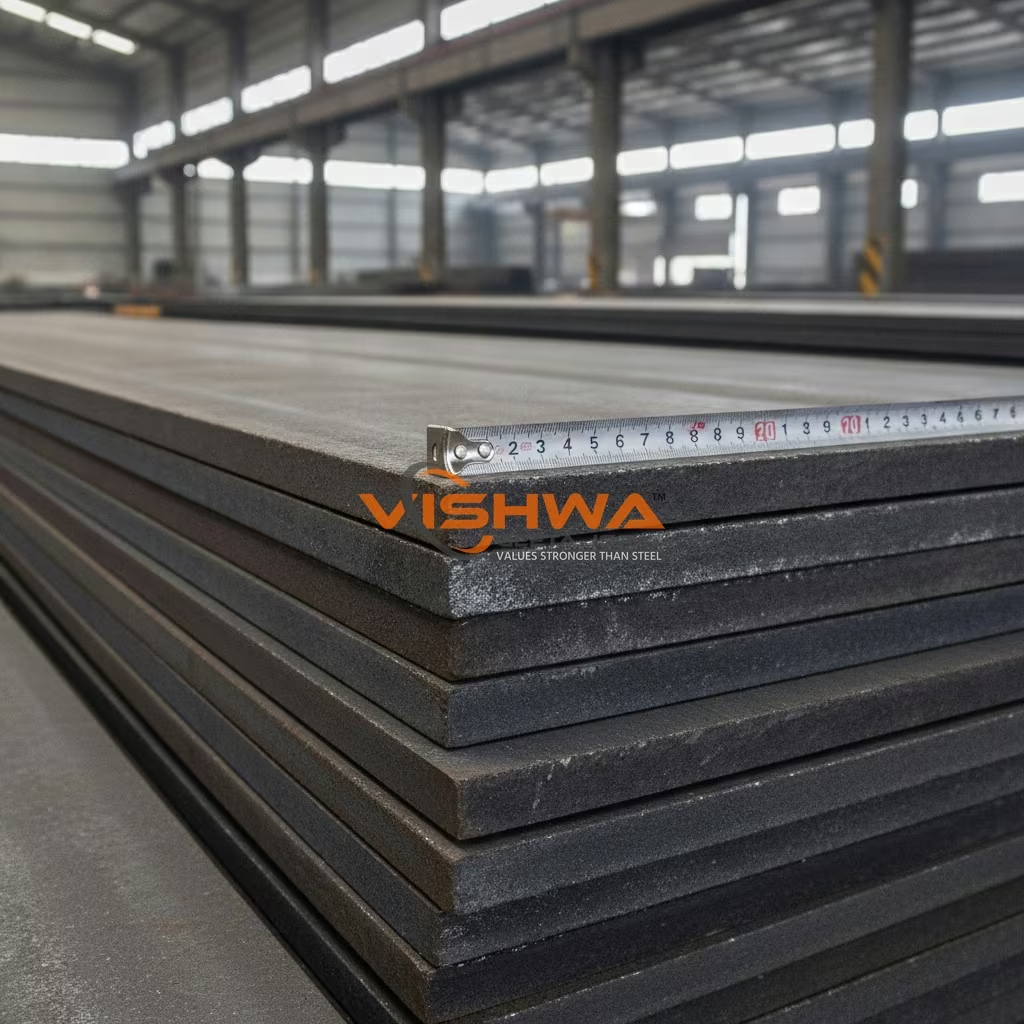
Stack of MS plates: thickness drives the weight
To find the weight of an MS plate, multiply its length (m) by its width (m) by its thickness (mm) by 7.85. The answer is in kilograms. A 2.5 m × 1.25 m plate that is 10 mm thick weighs 2.5 × 1.25 × 10 × 7.85 = 245.3 kg. Use the MS plate weight calculator below to do this for any size, in millimetres, metres, feet or inches.
Free MS Plate Weight Calculator
Theoretical weight using mild steel density of 7,850 kg/m³. Actual weight can differ slightly because of rolling tolerance; final billing is by weighbridge weight. Check today's rate at vgisteel.com/live.
MS Plate Weight Formula
An MS plate is a flat block of steel, so its weight is simply its volume multiplied by the density of mild steel, which is about 7,850 kg per cubic metre.
Formula in Metres and Millimetres
Weight (kg) = Length (m) × Width (m) × Thickness (mm) × 7.85
The factor 7.85 comes from the density: 7,850 kg/m³ divided by 1,000 to allow thickness in millimetres. It also gives a useful shortcut: every 1 mm of thickness adds 7.85 kg per square metre of plate. A 6 mm plate is 6 × 7.85 = 47.1 kg/m², and a 12 mm plate is 94.2 kg/m².
Formula When Sizes Are in Feet or Inches
Many fabrication drawings and site orders in India still use feet for plate size and millimetres or inches for thickness.
Length and Width in Feet, Thickness in mm
Weight (kg) = Length (ft) × Width (ft) × Thickness (mm) × 0.7293
The factor 0.7293 is 7.85 multiplied by 0.0929, the number of square metres in one square foot.
Thickness in Inches
Convert the thickness to millimetres first by multiplying by 25.4, then use the metric formula. For example, a 1/2-inch plate is 12.7 mm thick and weighs about 99.7 kg/m².
Using the Formula for Stainless Steel or Aluminium
The method is the same for any metal plate: volume multiplied by density. Only the factor changes. Swap 7.85 for the factor of the metal you are weighing. The calculator above is set for mild steel only.
| Metal | Approx. density (kg/m³) | Factor (kg per m² per mm) | 10 mm plate (kg/m²) |
|---|---|---|---|
| Mild steel (MS) | 7,850 | 7.85 | 78.5 |
| Stainless steel (304) | about 7,930 | about 7.93 | about 79.3 |
| Aluminium | about 2,700 | about 2.70 | about 27.0 |
Exact density varies a little between grades and alloys, so treat these as estimates and use the supplier's own figure for billing.
MS Plate Weight Chart by Thickness
The chart below is calculated from the same formula. The kg per sq ft column helps when plates are sized in feet, and the last three columns show the weight of common example plate sizes so you can sense-check a quote quickly.
| Thickness (mm) | Weight (kg/m²) | Weight (kg/ft²) | 8 × 4 ft sheet (kg) | 1250 × 2500 mm plate (kg) | 1500 × 6000 mm plate (kg) |
|---|---|---|---|---|---|
| 3 | 23.55 | 2.19 | 70.0 | 73.6 | 212.0 |
| 4 | 31.40 | 2.92 | 93.3 | 98.1 | 282.6 |
| 5 | 39.25 | 3.65 | 116.7 | 122.7 | 353.3 |
| 6 | 47.10 | 4.38 | 140.0 | 147.2 | 423.9 |
| 8 | 62.80 | 5.83 | 186.7 | 196.3 | 565.2 |
| 10 | 78.50 | 7.29 | 233.4 | 245.3 | 706.5 |
| 12 | 94.20 | 8.75 | 280.0 | 294.4 | 847.8 |
| 16 | 125.60 | 11.67 | 373.4 | 392.5 | 1,130.4 |
| 20 | 157.00 | 14.59 | 466.7 | 490.6 | 1,413.0 |
| 25 | 196.25 | 18.23 | 583.4 | 613.3 | 1,766.3 |
| 32 | 251.20 | 23.34 | 746.8 | 785.0 | 2,260.8 |
| 40 | 314.00 | 29.17 | 933.5 | 981.3 | 2,826.0 |
| 50 | 392.50 | 36.46 | 1,166.9 | 1,226.6 | 3,532.5 |
Common Inch Thicknesses
| Thickness (inch) | Thickness (mm) | Weight (kg/m²) |
|---|---|---|
| 1/4" | 6.35 | 49.85 |
| 3/8" | 9.53 | 74.81 |
| 1/2" | 12.70 | 99.69 |
| 3/4" | 19.05 | 149.54 |
| 1" | 25.40 | 199.39 |
Weight per Running Metre for Common Widths
When plates are cut to length from a fixed width, it is easier to think in kg per metre of length. Multiply the kg/m² figure by the width in metres, then by the length you need. The widths below are common examples; confirm the widths available before ordering.
| Thickness (mm) | 1250 mm wide (kg/m) | 1500 mm wide (kg/m) | 2000 mm wide (kg/m) | 2500 mm wide (kg/m) |
|---|---|---|---|---|
| 5 | 49.1 | 58.9 | 78.5 | 98.1 |
| 6 | 58.9 | 70.7 | 94.2 | 117.8 |
| 8 | 78.5 | 94.2 | 125.6 | 157.0 |
| 10 | 98.1 | 117.8 | 157.0 | 196.3 |
| 12 | 117.8 | 141.3 | 188.4 | 235.5 |
| 16 | 157.0 | 188.4 | 251.2 | 314.0 |
| 20 | 196.3 | 235.5 | 314.0 | 392.5 |
| 25 | 245.3 | 294.4 | 392.5 | 490.6 |
For example, 3.2 m of a 1500 mm wide, 10 mm plate weighs 117.8 × 3.2 = about 376.8 kg.
Worked Examples
Example 1: Metric Plate
A plate 2 m long, 1.25 m wide and 10 mm thick: 2 × 1.25 × 10 × 7.85 = 196.25 kg.
Example 2: Plate Sized in Feet
A plate 8 ft × 4 ft and 12 mm thick: 8 × 4 × 12 × 0.7293 = about 280 kg.
Example 3: Base Plates for a Shed
Six base plates, each 600 mm × 400 mm × 16 mm: one plate is 0.6 × 0.4 × 16 × 7.85 = 30.14 kg, so six plates weigh about 180.9 kg. Add the cutting allowance your fabricator uses before ordering.
Why the Weight of an MS Plate Matters
- Pricing: MS plates are sold by weight, per kg or per tonne, so the weight decides the bill. Multiply the weight by the rate per kg to estimate cost before you ask for a quote.
- Transport: knowing the total tonnage tells you what size of truck you need and what the freight will cost.
- Lifting and handling: heavy plates need a crane, forklift or hoist rated for the load. A single 1500 × 6000 mm plate at 20 mm is over 1.4 tonnes.
- Design checks: engineers use plate weight to work out dead loads on structures and frames.
Theoretical Weight vs Actual Weight
The calculator gives the theoretical weight. The actual weight of a plate can be a little higher or lower because rolling mills produce plates within a permitted thickness tolerance, and surface condition varies. That is why steel is billed on the actual weight recorded on a weighbridge, not on a calculated figure.
- Ask for a weighbridge slip for every truck and match it to the GST invoice.
- If the difference between theoretical and actual weight looks large, check the plate thickness at several points with a calliper or micrometer.
- Ask for the mill test certificate to confirm the grade, usually E250 to IS 2062 for general fabrication.
MS Plates from Vishwa Geeta Ispat
We supply hot-rolled MS plates to IS 2062 from our Raipur yard for base plates, tanks, gussets and heavy fabrication, in thicknesses from 5 mm to 50 mm. Every order is billed by weighbridge weight with a GST invoice. See the MS plate product page, use our rate and weight calculator for other sections, or send your sizes on WhatsApp for today's delivered rate.
Frequently Asked Questions
How do you calculate the weight of an MS plate?
Multiply length in metres by width in metres by thickness in millimetres by 7.85. The result is the weight in kilograms, based on mild steel density of 7,850 kg/m³.
What is the weight of a 10 mm MS plate per square metre?
A 10 mm MS plate weighs 78.5 kg per square metre, because each millimetre of thickness adds 7.85 kg per square metre.
What is the density of mild steel used in the calculator?
The calculator uses 7,850 kg/m³, the standard density used for mild steel plate weight calculations.
How do I calculate plate weight when the size is in feet?
Multiply length in feet by width in feet by thickness in millimetres by 0.7293. For example, an 8 ft × 4 ft × 12 mm plate weighs about 280 kg.
Why is the actual plate weight different from the calculated weight?
Plates are rolled within a permitted thickness tolerance, so actual weight can vary slightly from the theoretical figure. Steel is billed on weighbridge weight for this reason.
What is the weight of an 8 × 4 ft MS sheet?
An 8 × 4 ft sheet covers about 2.97 m², so its weight depends on thickness: about 116.7 kg at 5 mm, 140.0 kg at 6 mm, 233.4 kg at 10 mm and 280.0 kg at 12 mm.
Can I use this calculator for stainless steel or aluminium plates?
The calculator is set for mild steel at 7,850 kg/m³. For other metals, use the same formula with that metal's factor instead of 7.85, for example about 7.93 for 304 stainless steel or about 2.70 for aluminium.
How much does a chequered plate weigh compared with a plain MS plate?
A chequered plate weighs more than a plain plate of the same base thickness because of its raised pattern. The calculator gives the plain-plate weight only; use the manufacturer's chequered plate table for the extra pattern weight.
How do I estimate the cost of an MS plate?
Calculate the total weight in kg and multiply it by the rate per kg. Check today's rate at vgisteel.com/live and confirm the delivered rate, including GST and freight, with the supplier.
Calculate the weight, check the live rate, then send us your sizes for a delivered quote from Vishwa Geeta Ispat.