GI Angle: Sizes, Weight Chart, Zinc Coating and Buying Guide
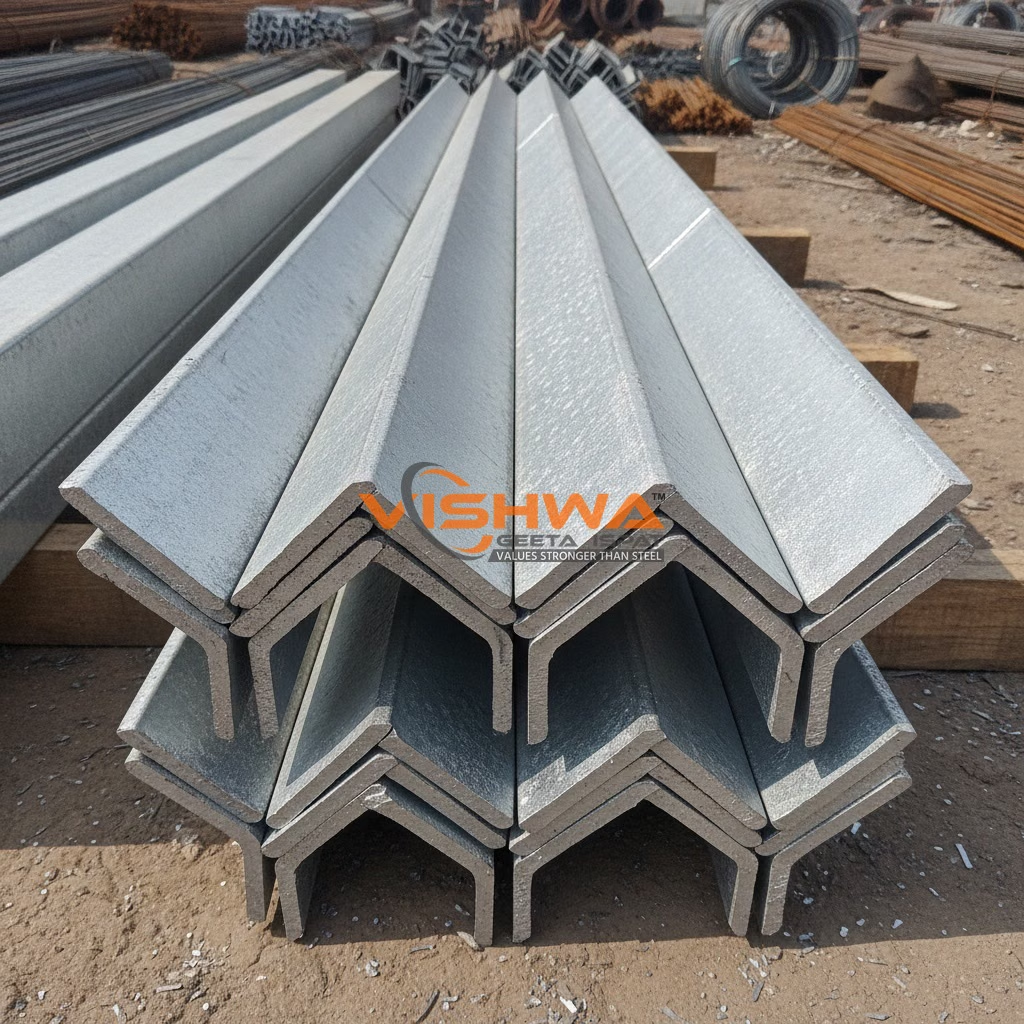
Hot-dip galvanized GI angles. Check the zinc coating in g/m² against IS 4759 before you buy.
A GI angle is a mild steel L-shaped angle that has been galvanized, which means coated with zinc so it does not rust easily. The base angle is the same hot rolled section used as a plain MS angle (IS 2062 steel, sizes as per IS 808), and the zinc layer is added afterwards, usually by hot-dip galvanizing as per IS 2629. Common sizes run from 25 x 25 x 3 mm to 100 x 100 x 10 mm in 6 metre lengths. A GI angle weighs only about 2 to 4 percent more than the same MS angle, but lasts far longer outdoors. Below you will find the size and weight chart, the zinc coating rules, hot-dip vs cold-dip, the HSN code and the checks to make before you buy.
What Is a GI Angle?
"GI" stands for galvanized iron. In practice the steel is mild steel, not iron, and the trade name has simply stuck. A GI angle has two legs at 90 degrees to each other. When both legs are the same width it is an equal angle (for example 50 x 50 x 5), and when the legs differ it is an unequal angle (for example 75 x 50 x 6). The three numbers are leg A, leg B and thickness, all in millimetres.
The zinc protects the steel in two ways. It forms a barrier between the steel and moisture, and it corrodes in place of the steel (sacrificial protection), so even a small scratch does not start a rust spot straight away. This is why GI angles are chosen for anything that stays outside or near water for years.
GI Angle Size and Weight Chart
Because galvanizing only adds a thin zinc skin, the size range of GI angle follows the MS angle range. The table below shows the common equal angle sizes with the steel weight worked out from the standard formula, plus the weight of a 6 metre length. These are calculated values for the bare steel. For the full IS 808 list, see our MS angle weight chart.
| Size (mm) | Steel weight (kg/m) | Weight per 6 m length (kg) | Approx. zinc added |
|---|---|---|---|
| 25 x 25 x 3 | 1.11 | 6.6 | about 4% |
| 30 x 30 x 3 | 1.34 | 8.1 | about 4% |
| 35 x 35 x 5 | 2.55 | 15.3 | about 3% |
| 40 x 40 x 3 | 1.81 | 10.9 | about 4% |
| 40 x 40 x 5 | 2.94 | 17.7 | about 3% |
| 45 x 45 x 5 | 3.34 | 20.0 | about 3% |
| 50 x 50 x 5 | 3.73 | 22.4 | about 3% |
| 50 x 50 x 6 | 4.43 | 26.6 | about 3% |
| 65 x 65 x 6 | 5.84 | 35.0 | about 3% |
| 75 x 75 x 6 | 6.78 | 40.7 | about 3% |
| 75 x 75 x 8 | 8.92 | 53.5 | about 2% |
| 90 x 90 x 8 | 10.80 | 64.8 | about 2% |
| 100 x 100 x 10 | 14.91 | 89.5 | about 2% |
The "zinc added" column is an estimate based on the IS 4759 minimum coating mass explained below. Actual coating weight depends on the steel chemistry and the galvanizer, so bills are always made on the weighbridge weight of the finished GI material.
GI Angle Weight Formula
For an equal angle, the steel weight per metre is:
Weight (kg/m) = (2 x A - t) x t x 0.00785
where A is the leg width in mm and t is the thickness in mm. For an unequal angle use (A + B - t) x t x 0.00785. Example: a 50 x 50 x 5 angle gives (100 - 5) x 5 x 0.00785 = 3.73 kg/m. The formula ignores the small root radius, so it lands within a few percent of the IS 808 table value. You can also use our steel weight calculator.
Zinc Coating: How Much Is Enough?
For hot-dip galvanized structural steel, the minimum zinc coating is set by IS 4759. The standard links the coating mass to the thickness of the steel:
| Steel thickness | Minimum average coating (g/m²) | Roughly equal to |
|---|---|---|
| 5 mm and above | 610 | about 85 microns |
| 2 mm to under 5 mm | 460 | about 64 microns |
| 1.2 mm to under 2 mm | 340 | about 48 microns |
The micron figures are converted using the density of zinc (about 7.14 g/cm³, so 1 micron is about 7.14 g/m²). These minimums are for normal or rural conditions. For coastal or heavy industrial sites the standard says a higher coating should be agreed with the supplier.
Watch out for listings that quote only "120 gsm" or "180 gsm". Those figures are far below the hot-dip minimum for structural angles and usually point to a thin electro-galvanized or pre-galvanized finish, which is fine for indoor brackets but not for outdoor structures.
Hot-Dip vs Cold-Dip (Electro) GI Angle
| Point | Hot-dip galvanized | Cold-dip / electro-galvanized |
|---|---|---|
| Process | Cleaned angle is dipped in molten zinc (IS 2629 practice) | Zinc is deposited by electroplating, or a zinc-rich paint is applied |
| Coating | Thick, metallurgically bonded; typically 460 to 610 g/m² or more | Thin; often a fraction of the hot-dip figure |
| Look | Dull to bright grey, sometimes with a spangle pattern | Smooth, shiny and even |
| Outdoor life | Decades in normal atmospheres | Much shorter outdoors |
| Best for | Towers, solar structures, fencing posts, poles, sheds | Indoor racks, light brackets, decorative use |
| Cost | Higher per kg | Lower per kg |
If the angle will be cut or drilled after galvanizing, touch up the bare edges with zinc-rich paint. The best practice is to fabricate first and galvanize after, which our galvanizing and fabrication service handles.
Where GI Angles Are Used
- Solar panel mounting structures on rooftops and ground-mounted plants.
- Transmission and telecom towers, cross-arms and earthing work.
- Fencing posts and boundary frames for chain link and barbed wire.
- Cable trays and supports in plants, tunnels and substations.
- Sheds, canopies and greenhouse frames exposed to rain.
- Storage racks in humid warehouses and cold stores.
For bolted shelving, a slotted angle may suit better, and for complete galvanized frames see our GI structure range.
GI Angle HSN Code and GST
Steel angles fall under HSN heading 7216 (angles, shapes and sections of iron or non-alloy steel), and the GST rate on this heading is 18%. Within it, plain L sections under 80 mm height are usually listed as 7216 21, L sections of 80 mm and above as 7216 40, and some suppliers bill zinc-coated sections under 7216 99 10. The exact 8-digit code depends on the product description, so match it with your supplier's invoice and confirm with your tax advisor. Our landed cost guide shows how GST and freight add up on a steel order.
GI Angle Price: What Changes the Rate
GI angle is sold per kg, and the rate moves with the plain MS angle price plus the galvanizing charge. Marketplace listings vary widely, so treat any online figure as a rough guide only. The rate you actually pay depends on:
- Today's MS angle rate (it changes almost daily with the market).
- Hot-dip or electro coating, and the coating mass you specify.
- Size and thickness, since small and very large sections often cost more per kg.
- Brand (primary mill or secondary producer) and test certificate needs.
- Quantity, cut lengths and delivery distance.
For today's delivered rate, send your size list to us on WhatsApp or check the live steel price trend.
How to Check GI Angle Quality Before You Buy
- Ask for the mill test certificate for the base steel (IS 2062 grade, such as E250).
- Ask for the coating figure in g/m² or microns, and check it against the IS 4759 table above.
- Check the surface for bare spots, flaking, lumps of zinc or rust stains.
- Measure leg size and thickness with a vernier at a few points.
- Weigh a sample length and compare it with the chart. Much lower weight means thinner steel.
- Insist on weighbridge billing and a proper GST invoice.
Frequently Asked Questions
What is the full form of GI angle?
GI angle means galvanized iron angle. It is a mild steel L-shaped angle coated with zinc to protect it from rust. The name says "iron" for historical reasons, but the base metal is mild steel, usually IS 2062 grade.
What is the difference between MS angle and GI angle?
An MS angle is plain mild steel and needs painting to resist rust. A GI angle is the same section with a zinc coating, usually applied by hot-dip galvanizing. The GI angle costs more per kg but lasts much longer outdoors with little maintenance.
What is the standard length of a GI angle?
The common stock length is 6 metres. Some suppliers also offer other lengths or cut-to-size pieces on order, so confirm the length when you ask for a rate.
How much zinc coating should a GI angle have?
For hot-dip galvanized steel, IS 4759 sets a minimum average of 610 g/m² (about 85 microns) for steel 5 mm and thicker, and 460 g/m² for 2 mm to under 5 mm, in normal conditions. Coastal or industrial sites need a higher coating agreed with the supplier.
How do I calculate the weight of a GI angle?
Use (2 x A - t) x t x 0.00785 for an equal angle, with A and t in mm, to get kg per metre of steel. Then add about 2 to 4 percent for the zinc. For example, 50 x 50 x 5 is about 3.73 kg/m before galvanizing.
What is the HSN code for GI angle?
GI angles come under HSN heading 7216, which carries 18% GST. The 8-digit code used on invoices varies with the description, for example 7216 21 for L sections under 80 mm. Confirm the exact code with your supplier and tax advisor.
Send us the sizes, lengths, coating need and quantity. Vishwa Geeta Ispat will check stock and reply with today's delivered rate, billed on a weighbridge.