GI Pipe Weight Chart: IS 1239 Sizes, kg per Metre and Formula
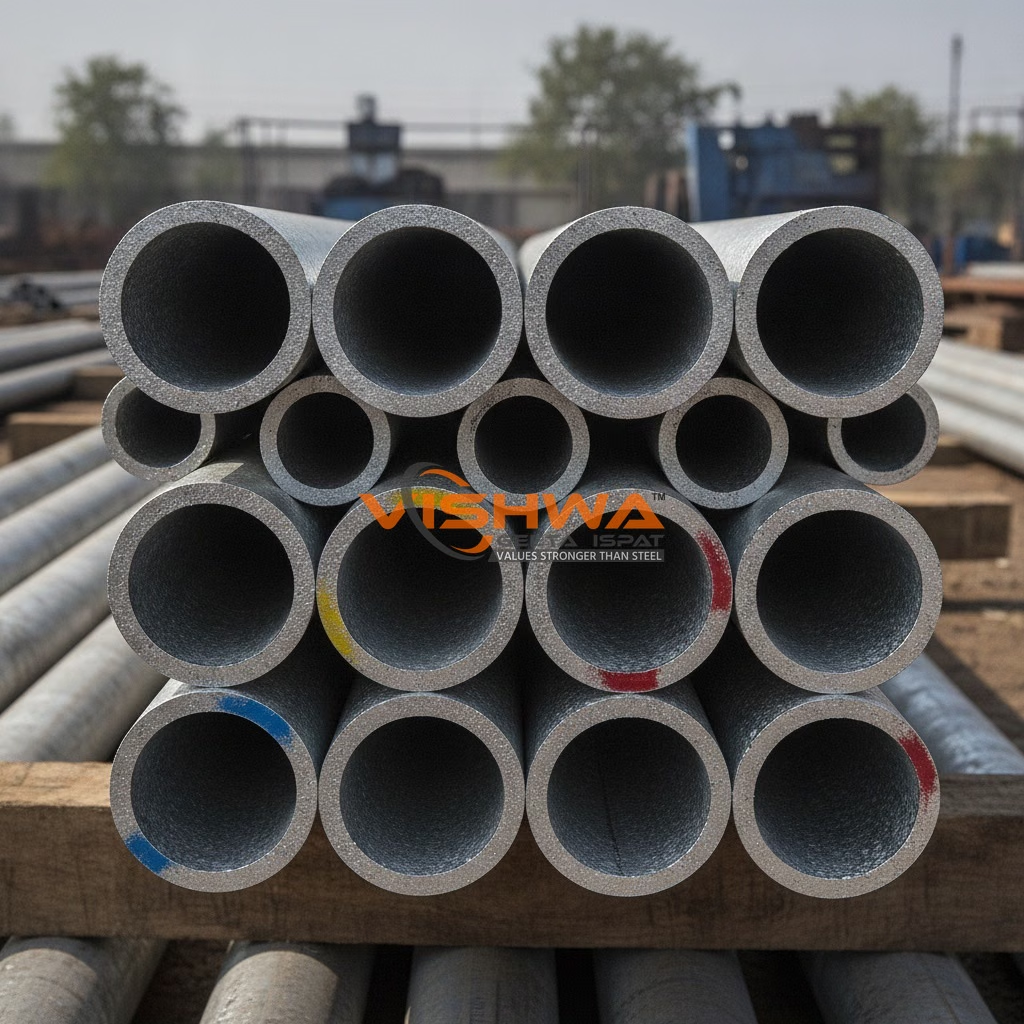
GI pipes to IS 1239. Check the class and wall thickness against the weight chart before you buy.
A GI pipe weight chart lists how much galvanised steel pipe weighs per metre for each size and class. In India, GI pipes are made to IS 1239 (Part 1) in three classes: Light (A), Medium (B) and Heavy (C). For example, a 15 NB (1/2 inch) pipe weighs about 0.95 kg/m in Light, 1.21 kg/m in Medium and 1.44 kg/m in Heavy class. The full chart below covers 15 NB to 150 NB, with weight per metre and per 6 metre length, the formula behind it, and how much the zinc coating adds.
What Is a GI Pipe?
GI stands for galvanised iron, although the pipe itself is mild steel. It starts as a welded (ERW) black steel tube and is then hot-dip galvanised. That means it is dipped in molten zinc, which coats both the outside and the inside surface. The zinc protects the steel from rust, which is why GI pipe is the usual choice for water lines, plumbing, fencing posts, railings and outdoor structures.
The sizes and wall thicknesses of GI pipe are the same as black MS pipe, because both come from the same IS 1239 tube. Only the zinc layer is extra. If you need the black pipe guide, see our MS pipe weight chart.
GI Pipe Weight Chart as per IS 1239 (Part 1)
The weights below are the nominal masses of plain-end tube listed in IS 1239 (Part 1). They match the formula given later within a few grams. NB means nominal bore, the trade size of the pipe. The outside diameter (OD) stays the same across all three classes; only the wall thickness changes.
| NB (mm) | NB (inch) | OD (mm) | Light (A) wall / kg/m | Medium (B) wall / kg/m | Heavy (C) wall / kg/m |
|---|---|---|---|---|---|
| 15 | 1/2" | 21.3 | 2.0 mm / 0.95 | 2.6 mm / 1.21 | 3.2 mm / 1.44 |
| 20 | 3/4" | 26.9 | 2.3 mm / 1.38 | 2.6 mm / 1.56 | 3.2 mm / 1.87 |
| 25 | 1" | 33.7 | 2.6 mm / 1.98 | 3.2 mm / 2.41 | 4.0 mm / 2.93 |
| 32 | 1-1/4" | 42.4 | 2.6 mm / 2.54 | 3.2 mm / 3.10 | 4.0 mm / 3.79 |
| 40 | 1-1/2" | 48.3 | 2.9 mm / 3.23 | 3.2 mm / 3.56 | 4.0 mm / 4.37 |
| 50 | 2" | 60.3 | 2.9 mm / 4.08 | 3.6 mm / 5.03 | 4.5 mm / 6.19 |
| 65 | 2-1/2" | 76.1 | 3.2 mm / 5.71 | 3.6 mm / 6.42 | 4.5 mm / 7.93 |
| 80 | 3" | 88.9 | 3.2 mm / 6.72 | 4.0 mm / 8.36 | 4.8 mm / 9.90 |
| 100 | 4" | 114.3 | 3.6 mm / 9.75 | 4.5 mm / 12.20 | 5.4 mm / 14.50 |
| 125 | 5" | 139.7 | Not made | 4.8 mm / 15.90 | 5.4 mm / 17.90 |
| 150 | 6" | 165.1 | Not made | 4.8 mm / 18.90 | 5.4 mm / 21.30 |
Light class stops at 100 NB. Sizes above 150 NB are usually made to other standards such as IS 3589 and are ordered separately.
GI Pipe Weight per 6 Metre Length
GI pipe is normally sold by the piece but billed by weight. Most pipes reach site in lengths of about 6 metres, so this table multiplies the chart weight by 6. Mill lengths can vary, so always check the length written on your invoice.
| NB | Light (A) kg per 6 m | Medium (B) kg per 6 m | Heavy (C) kg per 6 m |
|---|---|---|---|
| 15 NB (1/2") | 5.7 | 7.3 | 8.6 |
| 20 NB (3/4") | 8.3 | 9.4 | 11.2 |
| 25 NB (1") | 11.9 | 14.5 | 17.6 |
| 32 NB (1-1/4") | 15.2 | 18.6 | 22.7 |
| 40 NB (1-1/2") | 19.4 | 21.4 | 26.2 |
| 50 NB (2") | 24.5 | 30.2 | 37.1 |
| 65 NB (2-1/2") | 34.3 | 38.5 | 47.6 |
| 80 NB (3") | 40.3 | 50.2 | 59.4 |
| 100 NB (4") | 58.5 | 73.2 | 87.0 |
| 125 NB (5") | - | 95.4 | 107.4 |
| 150 NB (6") | - | 113.4 | 127.8 |
GI Pipe Weight Formula
You can work out the weight of any round steel pipe from its outside diameter and wall thickness:
Weight (kg/m) = (OD − t) × t × 0.02466
Here OD and t (wall thickness) are both in millimetres. The constant 0.02466 comes from the density of steel, 7,850 kg/m³, multiplied by π and converted to these units.
Worked example: 25 NB Medium GI pipe
- OD = 33.7 mm, wall thickness = 3.2 mm
- (33.7 − 3.2) × 3.2 × 0.02466 = 30.5 × 3.2 × 0.02466 = 2.41 kg/m
- For a 6 m pipe: 2.41 × 6 = about 14.5 kg
The result matches the IS 1239 figure in the chart. For quick sums on other sizes, use our MS pipe weight calculator; the steel weight is the same for GI pipe.
How Much Does Galvanising Add to the Weight?
The chart and formula give the steel weight only. The zinc coating adds a little more. IS 1239 (Part 1) points to IS 4736 for the hot-dip zinc coating on tubes, and IS 4736 sets a minimum coating mass per square metre of pipe surface (the 1986 text gives 400 g/m²).
Because the coating covers both the inside and outside of the pipe, its share depends on how thin the wall is. Working from that minimum coating, zinc adds roughly 2% to 5% to the steel weight:
- Small, thin pipes (15 to 20 NB Light): close to 4% to 5% extra
- Medium class in common sizes (25 to 50 NB): about 3% extra
- Heavy class and larger bores (80 NB and up): about 2% extra
Actual coating mass varies by mill, so treat these as estimates. When you buy by weight, the weighbridge slip is what counts. If you want to know how galvanising works on other steel, see our guide to GI angle sizes and zinc coating.
Light, Medium and Heavy Class: Which One Do You Need?
| Class | Colour band | Typical use |
|---|---|---|
| Light (A) | Yellow | Fencing, railings, light frames, low-pressure lines |
| Medium (B) | Blue | Household and building water supply, plumbing, general fabrication. The class sold most often. |
| Heavy (C) | Red | Higher-pressure lines, borewell columns, fire lines, heavy structural use |
Many mills paint a coloured band on each pipe to show the class: yellow for Light, blue for Medium and red for Heavy. Do not rely on the colour alone, though. Measure the wall thickness at the pipe end with a vernier and compare it with the chart, and check the IS 1239 and ISI marking printed on the pipe.
Checks Before You Buy GI Pipe
- Weigh a sample. Weigh one pipe, divide by its length and compare with the chart. A pipe that is well under the chart weight may have a thinner wall than the class you paid for.
- Check the marking. Look for the IS 1239 reference, the ISI mark, the size and the class or colour band.
- Look at the zinc finish. The coating should be continuous inside and out, with no bare black patches or heavy flaking.
- Confirm the ends. Plain-end pipe is for welding; screwed-and-socketed pipe has threads and a coupling for plumbing joints. Order the right one.
- Get weight-based billing in writing. Ask whether the quote is per piece or per kg, and ask for the weighbridge slip with the delivery.
Planning a larger structure with square or rectangular sections instead? See our MS square pipe weight chart.
Frequently Asked Questions
What is the weight of a 1 inch GI pipe per metre?
A 1 inch (25 NB) GI pipe to IS 1239 weighs about 1.98 kg/m in Light class, 2.41 kg/m in Medium class and 2.93 kg/m in Heavy class, plus a small extra for the zinc coating.
What is the weight of a 6 metre 2 inch GI pipe?
A 2 inch (50 NB) GI pipe weighs about 24.5 kg in Light class, 30.2 kg in Medium class and 37.1 kg in Heavy class for a 6 metre length, before adding the zinc coating.
How do you calculate GI pipe weight?
Use Weight (kg/m) = (OD − wall thickness) × wall thickness × 0.02466, with both sizes in millimetres. Multiply by the length in metres to get the weight of one pipe.
Is GI pipe weight the same as MS pipe weight?
The steel weight is the same, because both are made to the same IS 1239 sizes. GI pipe is slightly heavier, roughly 2% to 5%, because of the zinc coating on its inner and outer surfaces.
What do A, B and C class mean on GI pipes?
They are the IS 1239 wall classes: A is Light, B is Medium and C is Heavy. The outside diameter is the same; the wall gets thicker from A to C, so the pipe gets heavier and stronger.
Which IS code applies to GI pipes?
IS 1239 (Part 1) covers the sizes, wall thickness and weight of the steel tube. IS 4736 covers the hot-dip zinc coating applied to those tubes.
Need GI pipe in Raipur or anywhere in Chhattisgarh?
Vishwa Geeta Ispat supplies GI and MS pipes in Light, Medium and Heavy class, with weighbridge-verified dispatch. Send us the size, class and quantity on WhatsApp for today's rate and a written quote.