Chequered Plate Weight: kg/m² Chart, Formula and Sheet Weights
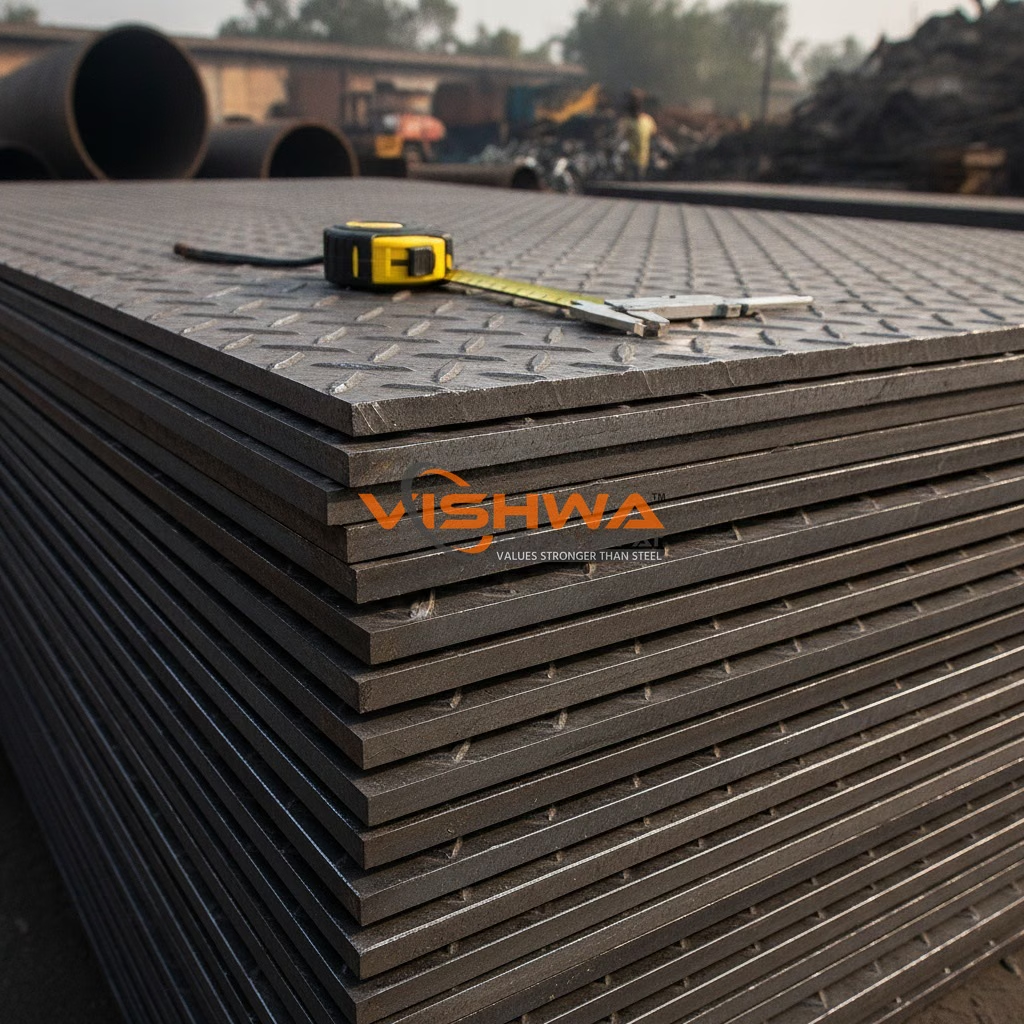
MS chequered plates. The raised pattern adds a few kg per square metre over a plain plate.
Chequered plate weight is the weight of the flat base plate plus a little extra for the raised pattern. Start with the plain plate: thickness in mm × 7.85 = kg per square metre, because mild steel has a density of 7,850 kg/m³. Then add the pattern. For common 3 mm to 8 mm MS chequered plates, supplier tables add about 3 kg/m² for the raised diamond or lug pattern, so a 6 mm chequered plate is usually listed at about 50.1 kg/m² against 47.1 kg/m² for a plain 6 mm plate. Multiply by the sheet area to get the weight of one sheet. Below you will find the full kg/m² chart, sheet weights for standard sizes, worked examples and what to check when the plates arrive.
What Is a Chequered Plate?
A chequered plate (also called a chequer plate, floor plate, tread plate or diamond plate) is a hot-rolled steel plate with a raised pattern rolled into one face. The pattern gives grip underfoot and under wheels, so these plates are used where people walk or vehicles move on steel. In India, steel chequered plates are made to IS 3502, which is under BIS mandatory certification, and the base steel is usually a structural grade such as IS 2062 E250.
The most common patterns are:
- Diamond (rhombus) lugs - the classic pattern on stair treads and walkway plates.
- Lentil or teardrop lugs - short raised bars set at angles to each other.
- Round bean - small rounded studs, seen more on light sheet.
The pattern adds weight because it is extra steel standing above the base thickness. How much depends on the pattern shape, its height and the mill, which is why two tables can show slightly different figures for the same thickness.
Chequered Plate Weight Formula
The weight calculation has two steps: work out the plain plate weight, then allow for the pattern.
Step 1: Plain plate weight
Weight (kg) = Length (m) × Width (m) × Thickness (mm) × 7.85
This is just volume times density. One square metre of steel that is 1 mm thick has a volume of 0.001 m³, and 0.001 × 7,850 = 7.85 kg. So every millimetre of thickness adds 7.85 kg to each square metre. The same rule is behind our MS plate weight calculator.
Step 2: Add the pattern allowance
There is no single correction factor that fits every chequered plate. In practice, buyers use one of these:
- The mill or supplier table (best) - the kg/m² the producer publishes for that thickness and pattern.
- A fixed allowance - about 3 kg/m² for 3 mm to 8 mm plates, rising to roughly 5 to 6.5 kg/m² for 10 mm and 12 mm plates in commonly published tables.
- A percentage - some estimators add around 10% to the plain weight on thin plates. On thick plates this overstates the pattern, so treat it as a rough check only.
For billing, the weighbridge weight of the actual lot is what counts. The chart is for estimating quantity, truck loading and structural dead load.
Chequered Plate Weight Chart (kg/m²)
The table shows the plain plate weight for each thickness (exact, from 7.85 × thickness) next to the chequered plate weight commonly published in Indian supplier tables for MS diamond-pattern plates. Thickness is the base thickness, not including the pattern.
| Base thickness (mm) | Plain plate (kg/m²) | Chequered plate, typical (kg/m²) | Pattern adds (kg/m²) |
|---|---|---|---|
| 3 | 23.55 | 26.55 | 3.0 |
| 4 | 31.40 | 34.40 | 3.0 |
| 5 | 39.25 | 42.25 | 3.0 |
| 6 | 47.10 | 50.10 | 3.0 |
| 8 | 62.80 | 65.80 | 3.0 |
| 10 | 78.50 | 83.40 | 4.9 |
| 12 | 94.20 | 100.60 | 6.4 |
Typical values are theoretical and for estimating only. Different mills and patterns (diamond, lentil, round bean) can vary by a kilo or two per square metre. Ask for the producer's IS 3502 table or test certificate when the exact figure matters.
Weight per square foot
One square metre is about 10.764 square feet. To convert, divide kg/m² by 10.764. For example, a typical 6 mm chequered plate at 50.1 kg/m² works out to about 4.65 kg per sq ft, and a 5 mm plate at 42.25 kg/m² to about 3.93 kg per sq ft.
Chequered Plate Sheet Weight for Standard Sizes
Chequered plates are commonly sold in sheets such as 1250 × 2500 mm (3.125 m²) and 1500 × 6000 mm (9 m²); other widths and cut lengths are also rolled. Sheet weight = kg/m² × sheet area.
| Base thickness (mm) | 1250 × 2500 mm sheet (kg) | 1500 × 6000 mm sheet (kg) | Approx. 1250 × 2500 sheets per tonne |
|---|---|---|---|
| 3 | 83.0 | 239.0 | 12 |
| 4 | 107.5 | 309.6 | 9 |
| 5 | 132.0 | 380.3 | 7.6 |
| 6 | 156.6 | 450.9 | 6.4 |
| 8 | 205.6 | 592.2 | 4.9 |
| 10 | 260.6 | 750.6 | 3.8 |
| 12 | 314.4 | 905.4 | 3.2 |
Sheet weights use the typical chequered values from the chart above. Plain sheets of the same size weigh less, for example a plain 6 mm 1250 × 2500 sheet is about 147.2 kg.
Worked Examples
Example 1: One 5 mm sheet, 1250 × 2500 mm
- Area = 1.25 × 2.5 = 3.125 m²
- Plain weight = 3.125 × 5 × 7.85 = 122.7 kg
- With a typical 3 kg/m² pattern allowance = 3.125 × 42.25 = about 132 kg
Example 2: Platform flooring, 6 m × 2 m in 6 mm plate
- Area = 12 m²
- Chequered weight = 12 × 50.1 = about 601 kg
- Add 3% to 5% for cutting waste when you order, depending on how well the layout fits the sheet size.
Example 3: Stair treads
Ten treads of 1000 × 300 mm in 5 mm plate: area = 10 × 1.0 × 0.3 = 3 m², so weight = 3 × 42.25 = about 127 kg. That is just under one 1250 × 2500 sheet by weight, but check the cutting layout, as ten 300 mm strips need 3,000 mm of length.
Where Chequered Plates Are Used and Which Thickness to Pick
| Use | Typical thickness range | Why |
|---|---|---|
| Cable trench and drain covers, light covers | 3 - 5 mm | Foot traffic only, light to lift |
| Stair treads, walkways, mezzanine floors | 5 - 6 mm | Good grip with a stiff enough surface on normal support spacing |
| Truck and trailer floors, loading docks, ramps | 6 - 8 mm | Wheel loads and impact |
| Heavy industrial platforms, plant floors | 8 - 12 mm | Machinery, trolleys and wider support spacing |
These ranges are general practice, not a design rule. The right thickness depends on the load and the spacing of the supporting angles or channels, so get the structural engineer's sign-off for platforms and vehicle floors.
Checks When Chequered Plates Arrive
- Measure base thickness between the lugs, not over them. A caliper reading across the pattern will look thicker than the plate really is.
- Check the BIS mark and IS 3502 on the plate or the mill test certificate, and the steel grade (for example IS 2062 E250).
- Weigh the lot on a weighbridge and compare with the chart weight for the number of sheets. A big shortfall usually means the plates are thinner than ordered.
- Look at the pattern - lugs should be even and fully formed, with no laminations, cracks or heavy rust pitting.
- Confirm sheet size and flatness before cutting, especially on long 6 m sheets.
If you also need flats or plain plates for the support frame, see our MS flat weight chart, or browse MS chequered plate stock at Vishwa Geeta Ispat.
Frequently Asked Questions
How do you calculate chequered plate weight?
Multiply length (m) × width (m) × base thickness (mm) × 7.85 to get the plain plate weight, then add the pattern. For 3 mm to 8 mm MS plates, commonly published tables add about 3 kg per square metre. Using the producer's own kg/m² table is the most accurate method.
What is the weight of a 6 mm chequered plate per square metre?
About 50.1 kg/m² in commonly published tables, compared with 47.1 kg/m² for a plain 6 mm plate. A 1250 × 2500 mm sheet weighs about 157 kg.
What is the weight of a 5 mm chequered plate?
About 42.25 kg per square metre, so a 1250 × 2500 mm sheet weighs about 132 kg and a 1500 × 6000 mm sheet about 380 kg.
Is the chequered plate thickness measured with the pattern?
No. The thickness quoted for a chequered plate is the base thickness, measured on the flat part between the lugs. The raised pattern is extra, which is why chequered plate weighs more than plain plate of the same thickness.
Which IS code covers steel chequered plates?
IS 3502 covers steel chequered plates in India and is under BIS mandatory certification. The base steel is usually a structural grade such as IS 2062.
How many 1250 × 2500 mm chequered sheets make one tonne?
Roughly 12 sheets of 3 mm, about 6 to 7 sheets of 6 mm, and about 4 sheets of 10 mm, using typical chequered weights. Actual counts depend on the mill's weight and tolerance.
Send the thickness, sheet size and quantity on WhatsApp. Vishwa Geeta Ispat will reply with today's rate for MS chequered plates and plain plates, with delivery and a weighbridge slip.