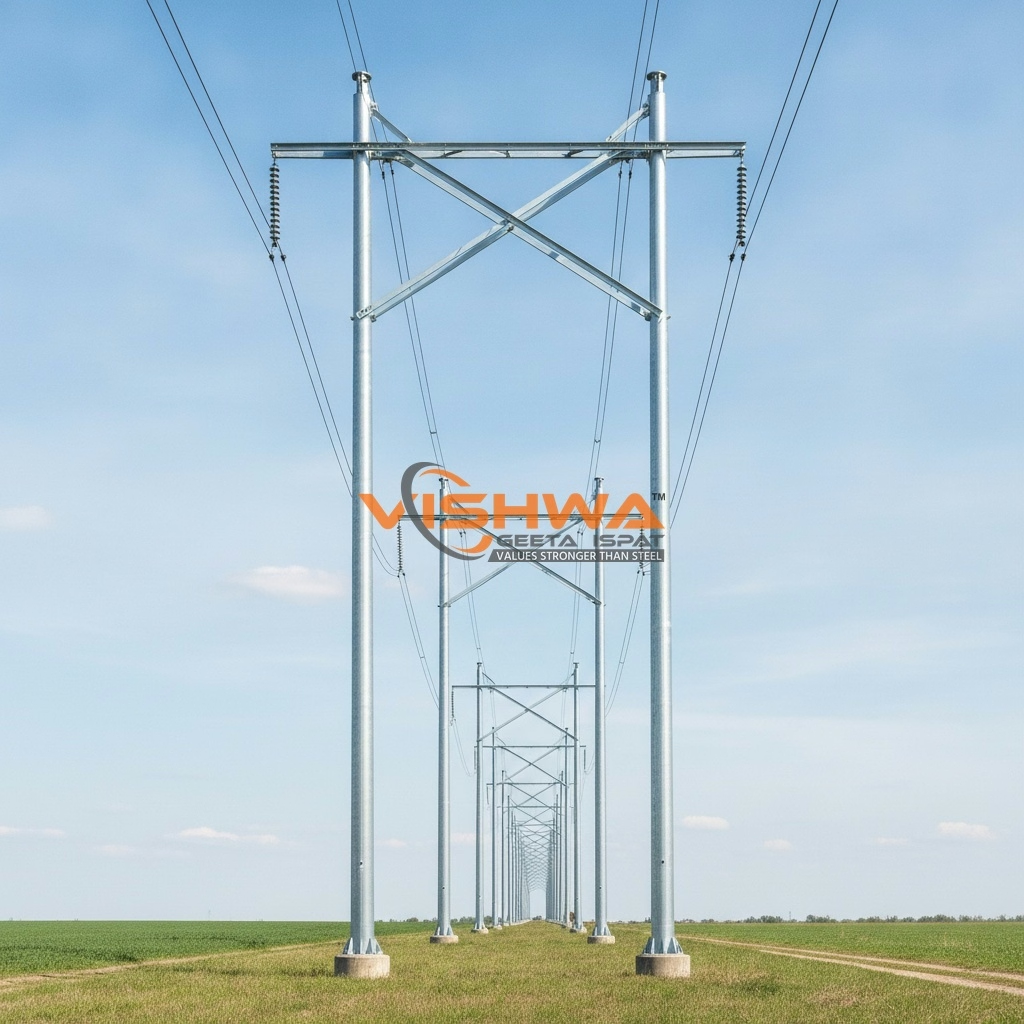
Row of RSJ steel electric poles supporting overhead power lines, related to current pole guide.
Current Pole Guide: Material, Height, Foundation & Load
"Current pole" is the everyday term most people in India use for an electric or utility pole. It looks simple — tall, wires hanging in controlled tension — but it keeps high-voltage lines elevated, maintains alignment pole to pole, and handles wind load, cable tension, and temperature changes for years without complaint. Nothing about it is actually simple.
Material Selection
| Material | Strength | Key Risk |
|---|---|---|
| RSJ Steel | High, predictable | Surface corrosion if uncoated |
| Prestressed Concrete | High, rigid | Internal cracking — invisible from outside |
| Wood | Moderate | Insects, moisture — gradual, often invisible |
| Composite | Moderate–high | Installation precision critical |
RSJ steel poles offer three practical advantages over concrete in urban utility work: lower transport weight, faster installation with standard equipment, and visual corrosion inspection without specialist tools. A proper galvanising or paint system significantly extends service life.
Height & Clearance
Taller isn't automatically better — height is a calculated trade-off. Too tall and wires pull harder than the base section can handle; too short and wires sag dangerously low, especially in summer as conductors expand. IS 5613 specifies minimum ground clearance for different voltage levels and crossing types. A conductor that meets clearance in January can fail the same check in May — thermal expansion increases conductor sag by 15–25% in summer versus winter, so height calculations must account for maximum operating temperature sag, not just installed sag.
Foundation — The Hidden Critical Part
The portion above ground gets all the attention; the buried part decides long-term stability. A shallow foundation or poorly compacted backfill causes gradual tilt over years, not immediate failure — which is why the connection to installation quality is often missed.
- Standard distribution poles (8–11m): foundation depth = pole height ÷ 6, minimum 1.5m
- Tension/angle poles: deeper foundation calculated from lateral load
- Soft/waterlogged soil: increase depth or use a concrete surround
- Rocky ground: drill precisely to avoid stress concentration at the base
Foundation-related causes account for the majority of premature pole failures in Central India — ahead of material defects or overloading. Periodic soil condition checks after monsoon flooding are more cost-effective than post-failure replacement.
Weather Impact Over the Years
Daily thermal cycling creates micro-fatigue at connection points, crossarm bolts, and stay wire anchors. Monsoon rain softens soil around the base, letting the pole rock under wind load and gradually widening the foundation hole. Uncoated mild steel loses 0.1–0.2mm of section thickness per year to corrosion in a normal environment — 2–4× faster at the soil-air interface where moisture and oxygen concentration are highest. A zinc-rich primer plus finish coat, touched up at 5–7 year intervals, dramatically extends service life at a fraction of replacement cost.
Overloading Without Anyone Noticing
A pole designed to carry only power cables gradually accumulates broadband wires, fibre, CCTV cameras, and street light arms — each addition seems small, but collectively the bending moment at the base rises well beyond the original design. Unauthorised attachments are a leading cause of premature pole failure in Indian distribution networks. Spacing between poles is never arbitrary either — it's calculated from cable weight, design wind speed, maximum sag, and clearance requirements; a single span 15% longer than design forces adjustments across adjacent spans.
Modern Poles Carry More
A single urban pole may now support LT/HT power conductors, broadband and fibre, 4G/5G small-cell antennas, LED street lighting, CCTV, and environmental sensors — an evolution from single-purpose power support to multi-utility infrastructure that mostly happened without structural reassessment. Smart city projects now specify poles as multi-utility supports from the outset — heavier-section RSJ poles, galvanised finish, pre-drilled attachment brackets, and cable management channels designed for planned load, not added incrementally.
Installation & Inspection Checklist
- Confirm total planned load — today's conductors plus likely future additions — and design for the 10-year load
- Verify route clearance per IS 5613, accounting for maximum temperature sag
- Assess soil bearing capacity, drainage, and groundwater level before installation
- Confirm span layout from cable weight, wind speed, sag limit, and clearance requirement
- Plan corrosion protection: primer + finish coat at installation, inspection every 5–7 years (2–3 years coastal/industrial)
- Schedule periodic alignment checks — don't wait for visible tilting
Frequently Asked Questions
What is a current pole?
Everyday term for an electric or utility pole — the vertical structure supporting overhead power lines and maintaining conductor alignment. RSJ steel and prestressed concrete are the two most common types in India.
Why do current poles lean over time?
Soil settlement, waterlogged ground, insufficient foundation depth, repeated wind pressure, and added loads from telecom/CCTV attachments — usually gradual lean rather than sudden failure.
Can a current pole carry internet and CCTV cables too?
Often yes in practice, but every addition increases load and wind-exposed area. Residual structural capacity should be assessed before adding attachments to an existing pole.
What decides pole spacing and height?
Ground clearance (IS 5613), conductor sag at maximum operating temperature, cable weight and tension, design wind speed, and soil bearing capacity.
What is an RSJ pole?
A utility pole fabricated from Rolled Steel Joist (I- or H-section) steel — lighter than concrete of equivalent strength, easier to transport and install, and visually inspectable for corrosion without specialist tools.
Share pole height, load requirement, and quantity — Vishwa Geeta Ispat will confirm section size, weight per piece, and current rate same working day.
Contact Us on WhatsApp