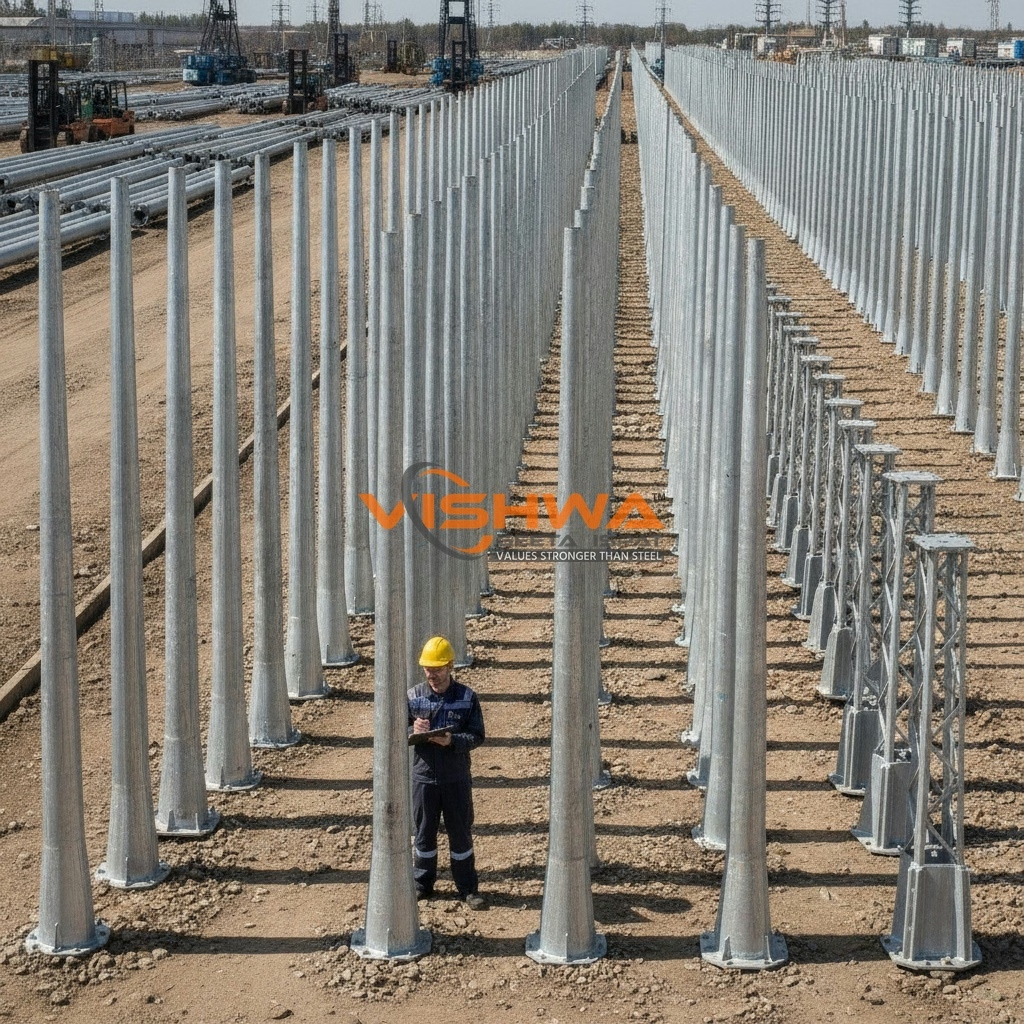
Different types of steel electric poles at a stockyard, related to electric pole types and procurement.
Electric Pole Types & Procurement Guide
A residential lane, an industrial feeder, and a high-voltage corridor can't use the same standard pole profile without compromising either cost or safety. Matching pole type to application — and knowing what to check before accepting a supplier quote — prevents both overdesign and underdesign.
Electric Pole Types by Application
- Distribution poles: residential/commercial LT networks, moderate height (8–9m), consistent spacing, quick service access
- Street lighting poles: dedicated road/colony illumination, height matched to road width, lamp arm geometry tuned to lighting calculation
- Industrial feeder poles: factory/warehouse supply, heavier sections, deeper foundations for higher current loads and vibration
- High-voltage corridor poles: HT transmission between substations and towns, stronger sections, larger clearances, tighter alignment control
- Special purpose poles: tension turns, dead-end terminations, river/road crossings — heavier than standard poles, designed for specific lateral loads
Visual uniformity matters more than people realise on distribution/street routes — a route with mixed pole heights and styles looks unmaintained even when structurally sound. On HT corridors, even one wrong pole in a long row can affect an entire transmission line's reliability — failures take longer to diagnose and repair on energised lines is operationally complex.
Material Choice
| Material | Where It Performs Best | Key Consideration |
|---|---|---|
| Concrete | Long service life, low rust risk, exposed zones | Heavier — plan transport/lifting logistics for narrow streets in advance |
| Steel (RSJ/Tubular) | Custom fittings, pre-drilled mounting for CCTV/lighting/telecom | Coating quality is critical — durability can drop by ~50% without proper galvanising in humid/coastal/industrial environments |
| Hybrid/Project-specific | Multi-utility mounting, phased network upgrades | Tailored to documented load analysis |
Pre-Order Checklist
Correct height is a safety requirement, not a cosmetic choice — clearance must be checked at maximum operating temperature (typically a summer afternoon), not the ambient temperature when the line was strung. Before ordering, confirm:
- Conductor and accessory load summary — present plus reasonable future additions
- Wind zone and terrain exposure, validated against IS 875 design wind speed
- Soil condition and foundation depth — confirmed by site investigation, not assumed
- Corrosion class and coating requirement, defined per environment (urban/coastal/industrial)
- Dispatch sequence mapped to civil and erection readiness on site
- Accessory inclusion — base plate, crossarms, stay rods specified or excluded clearly
Procurement Checklist — Comparing Supplier Quotes Fairly
| Parameter | What to Ask | Why It Matters |
|---|---|---|
| Material grade | Steel grade certificate, concrete mix design, test references | Controls structural reliability and service life |
| Coating/finish | Galvanisation thickness in microns, paint spec, DFT | Determines corrosion resistance over 15–25 years |
| Dimensional accuracy | Tolerance on length, base diameter, taper | Reduces fitment rework on site |
| Accessory inclusion | Base plate, crossarms, stay assemblies — included or extra? | Avoids cost surprises and incompatible mixed sourcing |
| Commercial terms | Freight, unloading, taxes, payment cycle, warranty scope | Avoids hidden costs during and after dispatch |
A quote 15% cheaper than market often hides one of: thinner steel section, lower-grade galvanising, missing accessories, longer lead time, or weaker commercial terms. Compare total delivered value against documented specifications, not just the headline rate per piece.
Frequently Asked Questions
What are the main electric pole types by application?
Distribution, street lighting, industrial feeder, high-voltage corridor, and special-purpose (tension/dead-end/crossing) poles — each engineered for a different load and clearance requirement.
Should I choose concrete or steel poles?
Concrete suits long service life and low rust risk but is heavier to transport; steel is easier to handle and customise but needs proper galvanising to match that durability.
Why does clearance need to be checked at maximum temperature?
Conductor sag increases with heat — a clearance check done at installation-time ambient temperature can fail every summer at peak thermal sag.
Why is a much cheaper pole quote often risky?
It commonly hides a thinner section, lower coating grade, missing accessories, or weaker commercial terms — compare total delivered value, not headline price.
What should be confirmed before placing an electric pole order?
Load summary, wind zone validation, soil/foundation condition, coating requirement per environment, dispatch sequencing, and accessory inclusion.
Share application, height, load, and location — Vishwa Geeta Ispat will confirm the right type and specification.
Contact Us on WhatsApp