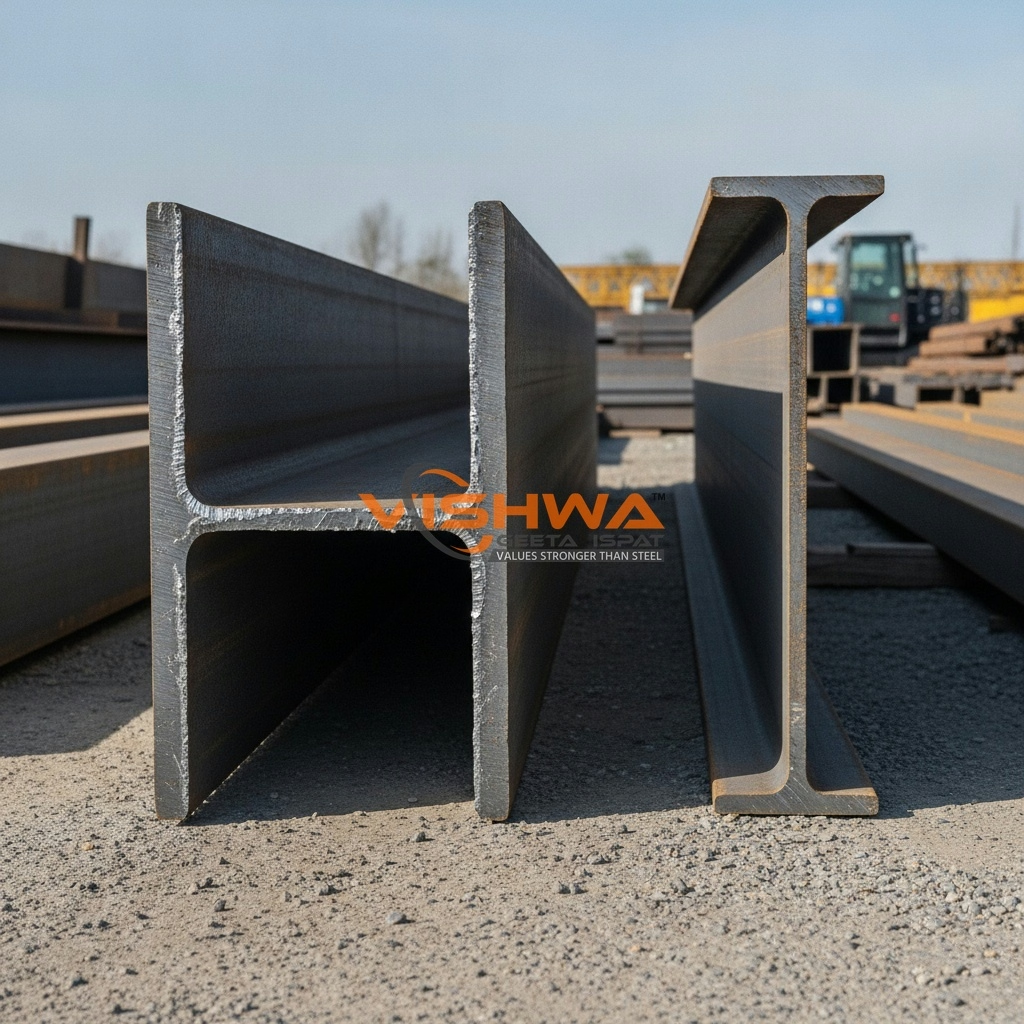
H-beam and I-beam sections side by side, illustrating the difference in flange geometry.
H Beam vs I Beam: Differences, Comparison & When to Use Each
From a distance, H-beams and I-beams both look like a capital "I" in steel. Up close, the flange geometry changes everything — lateral stability, load distribution, connection design, weight efficiency, and cost. In India, "I beam" typically refers to the ISMB (Indian Standard Medium Weight Beam) series under IS 808, while "H beam" refers to wide-flange sections (ISHB series or imported WF/UC sections) — and mixing up the terminology is exactly where procurement errors start.
The Shape Difference That Changes Everything
H Beam — Wide Flange Geometry
H-beams have wide, parallel flanges of near-uniform thickness, with flange width typically close to the section depth — giving a more "square" cross-section. This concentrates steel mass far from the neutral axis in both directions, delivering high section modulus on both major and minor axes. Parallel flanges also simplify bolted connections — flat mating surfaces need no angle corrections.
I Beam (ISMB) — Narrow Tapered Flange Geometry
ISMB I-beams have narrower flanges with a slight internal taper, giving the classic tall, narrow silhouette. This geometry is optimised for vertical bending — a deep web provides high moment of inertia for the depth while narrower flanges save steel in lower-stress zones. Tapered flanges do need taper washers for fully bearing bolted connections, a small extra fabrication step versus H-beams.
Complete Comparison Table
| Parameter | H Beam (Wide Flange) | I Beam (ISMB) |
|---|---|---|
| Flange geometry | Wide, parallel, near-uniform | Narrower, slightly tapered |
| Lateral stability | High | Lower — needs restraint at intervals |
| Column suitability | Excellent — near-equal stiffness both axes | Poor — low minor-axis stiffness |
| Crane girder suitability | Yes | No — insufficient lateral capacity |
| Weight per metre | Generally higher | Generally lower |
| Typical applications | Industrial sheds, columns, crane girders, wide spans | Floor beams, mezzanines, secondary beams, moderate spans |
General comparison — actual performance depends on the specific section size, grade, span, and load. Always compare exact section properties from the IS 808 table, and validate final selection with a structural engineer.
Cost — The Correct Comparison
H-beams cost more per metre than ISMB sections of equivalent nominal depth because they carry more steel (higher kg/m from wider flanges). But total project cost isn't the same as per-metre cost: a single H-beam spanning 20 metres may replace four ISMB sections plus two intermediate columns and their foundations. Once column and foundation cost is included, the H-beam solution is often less expensive overall for wide-span industrial applications — evaluate total structural system cost, not just beam unit price.
Installation & Handling
ISMB I-beams are lighter and easier to handle in constrained spaces — inside existing buildings, between floor levels, or with limited crane access. H-beams are heavier but tend to sit more stably during installation; the wider flange base reduces tipping or twisting on temporary supports before final lift. For both types, confirm crane capacity against the beam's actual kg/m and piece length before delivery — a mismatch is the most common preventable erection delay.
The Decision Framework
The choice is never about which "looks stronger" — it's about which section meets the actual load conditions most efficiently.
Use H-Beam When
- The structure is an industrial shed column or wide-span rafter (12m+)
- The beam acts as a column carrying combined axial + bending loads
- A crane runway girder is needed — H-beam is the only viable choice
- Wind, seismic, or other significant lateral loads are part of the design
Use I-Beam When
- The span is moderate (4–12m) and the load is primarily vertical
- It's a floor beam, mezzanine beam, or secondary framing member
- Weight efficiency and lower per-metre cost matter more than lateral stability
Frequently Asked Questions
What is the main difference between H beam and I beam?
H-beams have wide, parallel flanges optimised for bidirectional strength and column behaviour; I-beams (ISMB) have narrower, tapered flanges optimised for vertical bending efficiency over moderate spans.
Which is cheaper, H beam or I beam?
Per metre, I-beam (ISMB) is usually cheaper since it uses less steel. But for wide spans, an H-beam solution can be cheaper overall once fewer columns and foundations are factored in.
Can I use an I-beam for a crane runway girder?
No — crane runway girders need the lateral stiffness and torsional resistance that only H-beams provide.
Which is easier to install on site?
I-beams are lighter and easier to handle in constrained spaces; H-beams sit more stably during installation due to their wider flange base.
Is H beam always the stronger choice?
Not universally — "stronger" depends on the load direction. I-beams are more weight-efficient for pure vertical bending; H-beams are stronger for combined/lateral loading and column applications.
Share your span, load type, and application — Vishwa Geeta Ispat will recommend the right section with a same-day quote.
Contact Us on WhatsApp