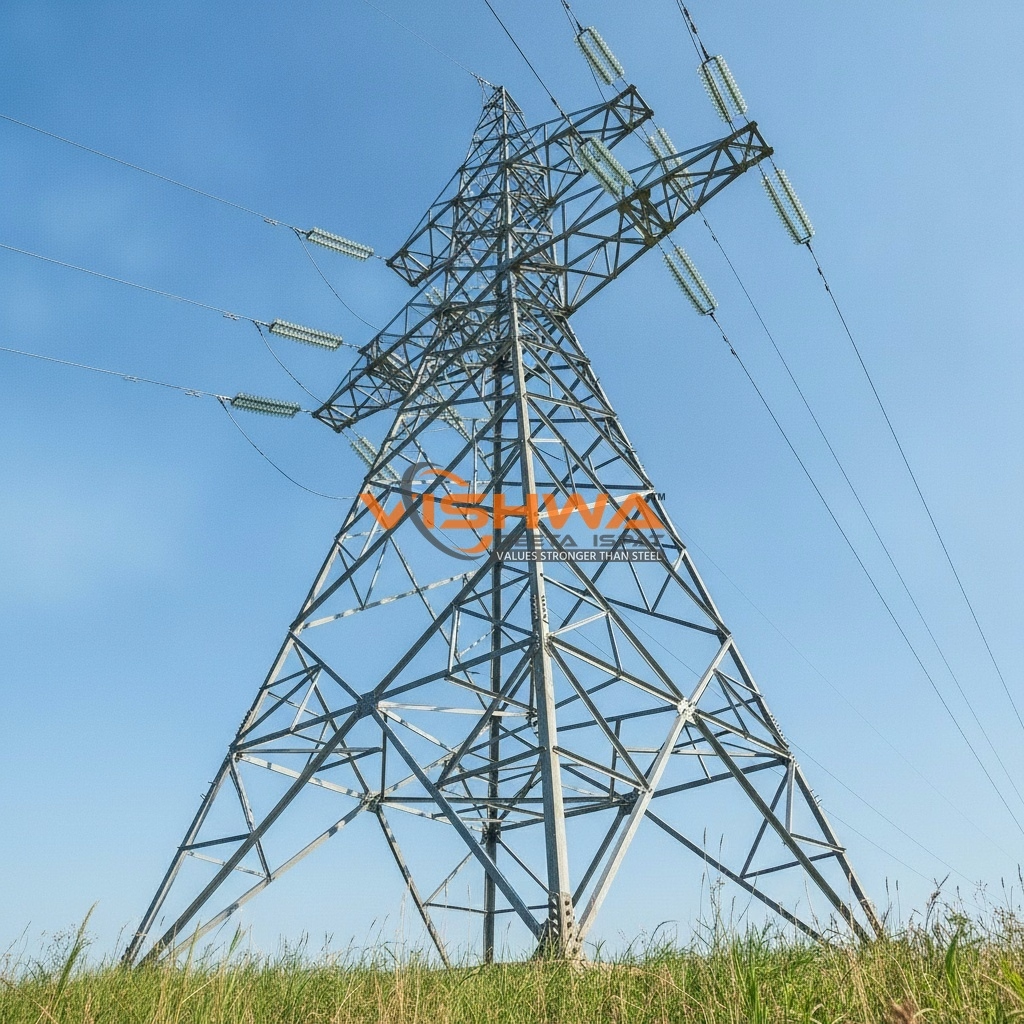
High voltage transmission tower with insulator strings, related to high voltage electric pole safety.
High Voltage Electric Pole: Insulators, Clearance & Safety
A high-voltage electric pole carries high-tension lines across long distances at 11kV, 33kV, 66kV, and higher — requiring greater clearance, stronger structural sections, more robust insulators, and deeper, more carefully engineered foundations than a last-mile distribution pole handling 415V or 11kV supply.
Insulators & Fittings — the Components That Make HT Poles Safe
Insulators perform two simultaneous functions. Electrically, they prevent current leakage from the energised conductor to the grounded pole body — without them, the pole becomes a direct fault path to ground. Mechanically, they support the conductor's dead weight plus ice or wind load and transfer it to the crossarm without creating a conductive path.
- Pin insulators: LT and 11kV lines with modest suspension loads
- Disc insulators (cap-and-pin): strung in series for 11kV and above — typically 2 discs for 11kV, 3 for 33kV, 6–8 for 66kV
- Long rod insulators: one-piece alternative where pollution severity makes disc string contamination a risk
- Composite polymer insulators: lighter, better in high-pollution coastal/industrial zones, increasingly specified for new lines
IS 731 specifies minimum creepage distance — the surface path length between energised and grounded ends — by voltage class and pollution severity zone. Heavy industrial or coastal pollution zones require significantly higher creepage distance than clean rural zones, even at the same voltage.
Crossarms & Vibration Dampers
Crossarms carry the insulator strings and conductors — they must be strong enough for conductor weight plus wind load, and stiff enough to maintain clearance under all loading conditions. Crossarm failure is one of the most common causes of HT line outages, almost always traceable to incorrect section specification or coating-failure corrosion. Stockbridge vibration dampers, clamped to the conductor at each span end, absorb Aeolian vibration (wind-induced oscillation) — their absence or incorrect placement leads to conductor fatigue failures within 5–10 years.
Safety Rules That Cannot Be Compromised
High voltage lines operate at energy levels where contact is immediately fatal — the safety framework is mandatory and legally enforceable under the Indian Electricity Rules and IS 5613.
The 3 Most Common HT Safety Violations
- Clearance calculated at installation, not maximum sag: a line strung in winter may fail summer clearance every year without anyone noticing until an incident
- Unauthorised attachments to HT pole bodies: telecom cables or CCTV brackets reduce insulation clearance and create fault paths
- Missing or deteriorated earthing: an unearthed HT pole body can energise at line voltage at a fault — immediately fatal on contact
Minimum Ground Clearance (IS 5613) — Indicative
- 11kV across national highway: 5.8m minimum
- 33kV across national highway: 6.1m minimum
- 66kV across national highway: 6.6m minimum
- 11kV in open country: 5.2m minimum
- 33kV in open country: 5.5m minimum
All clearances at maximum conductor sag under maximum operating temperature. Final specification from IS 5613 Parts 1, 2, and 3 by voltage class — verify with a structural engineer for each specific route and crossing type.
Specification Checklist for HT Pole Projects
- Confirm voltage class and IS 5613 clearance requirement at maximum sag, not installation temperature
- Calculate pole height as minimum clearance + maximum sag + safety margin — never estimate without sag analysis
- Select insulator type and quantity for voltage and pollution zone per IS 731
- Specify foundation depth by pole type — suspension poles 20–25% of height; tension/angle poles deeper with stay wires or concrete surround
- Include crossarm section, vibration dampers, and hardware specification
- Plan earthing electrode depth and connection, verified at installation and periodically thereafter
- Confirm pole section strength against full base moment calculation per IS 875 wind load for the terrain category
Frequently Asked Questions
What is a high voltage electric pole used for?
Carries high-tension lines across long distances between generation, transmission, and distribution points, supporting 11kV, 33kV, 66kV and higher voltages that need greater clearance and stronger structural sections than distribution poles.
Why is HT pole height so important?
Height maintains IS 5613 clearance at maximum conductor sag, manages the sag envelope over long spans as temperature rises, and reduces arcing risk. Insufficient height is a safety violation that can't be corrected after stringing without replacing the pole.
Do HT poles need stronger foundations than distribution poles?
Yes — heavier conductors, larger insulators and hardware, greater height, and wider spacing all increase lateral and vertical foundation loads. Suspension pole foundations are typically 20–25% of pole height; tension poles need more.
How do insulators help on an HT pole?
They prevent current leakage to the grounded pole body while mechanically supporting conductor weight and load — disc or long rod insulators are stacked in series to reach the creepage distance required by IS 731 for the voltage and pollution zone.
What safety rules apply to HT poles?
Minimum ground clearance by voltage/crossing type, minimum distance from structures, safe approach distances for workers, and mandatory earthing — all clearances verified at maximum conductor sag, not installation conditions.
Share voltage class, route, and crossing type — Vishwa Geeta Ispat will confirm the right pole specification.
Contact Us on WhatsApp