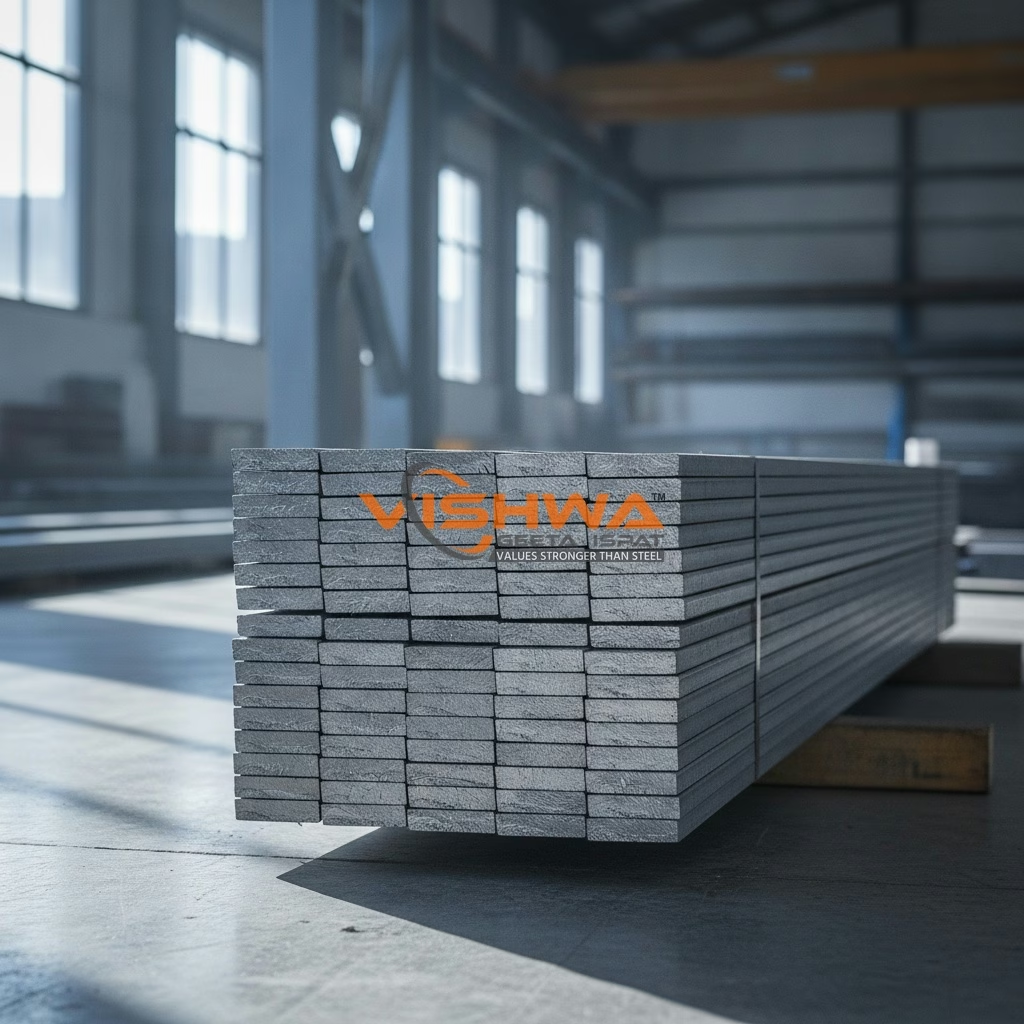
MS flat bar stock ready for dispatch, showing the rectangular cross-section.
MS Flat Bar: Sizes, Weight Chart & Uses in Construction
An MS flat bar is a rectangular-section mild steel bar — flat and wide rather than round or square — rolled to a fixed width and thickness and sold by length or by weight. Mills roll it across a wide range, roughly 18mm to 500mm in width and 3mm to 50mm in thickness, which is why a single section family covers everything from a light window-grill frame to a heavy base plate for industrial machinery.
MS Flat Bar Weight Chart (Standard Sizes)
Flat bar weight is calculated from a fixed formula, so any width-thickness combination can be checked without waiting for a supplier quote. The chart below covers the sizes most commonly stocked and ordered:
| Size (Width × Thickness, mm) | Weight (kg/m) |
|---|---|
| 25 × 5 | 0.98 |
| 25 × 6 | 1.18 |
| 32 × 6 | 1.51 |
| 40 × 6 | 1.88 |
| 40 × 8 | 2.51 |
| 50 × 6 | 2.36 |
| 50 × 8 | 3.14 |
| 50 × 10 | 3.93 |
| 65 × 8 | 4.08 |
| 75 × 8 | 4.71 |
| 75 × 10 | 5.89 |
| 100 × 10 | 7.85 |
| 100 × 12 | 9.42 |
| 150 × 12 | 14.13 |
| 200 × 16 | 25.12 |
| 250 × 20 | 39.25 |
Weights are calculated using the standard mild-steel density formula below, with a typical rolling tolerance of around ±1–2.5% on width and thickness depending on size band, per IS 1852. For a size not listed here, or to convert a full order into total tonnage and freight cost, use our steel weight & freight calculator.
How to Calculate MS Flat Bar Weight Yourself
MS flat bar weight per metre follows a fixed formula based on the density of mild steel (7,850 kg/m³):
Weight (kg/m) = Width (mm) × Thickness (mm) × 0.00785
Worked Example
For a 50mm × 10mm flat bar: 50 × 10 × 0.00785 = 3.93 kg/m. A 6-metre length of this bar would weigh approximately 23.6 kg. The same formula scales to any width or thickness — it's the standard method mills and traders both use to cross-check delivery weight against invoiced quantity, and the one used to build the chart above.
Common Grades & Specifications
Most MS flat bars sold in India are supplied against IS 2062 (the Indian standard for hot-rolled structural steel), typically grade E250 or E350 — commercial-grade mild steel suited to general fabrication and structural use. Where a project specifies an international standard instead — export orders, OEM/engineering work, or a specific mechanical property — flat bars are also rolled to ASTM A36, S275JR, S355J2, or EN8/EN9 for applications needing tighter control over carbon content and yield strength. Always confirm the exact grade against your drawing and request a Mill Test Certificate before dispatch, since visually identical flat bars can differ meaningfully in composition.
Uses of MS Flat Bar in Construction & Fabrication
- Gates, grills and railings: the most common application — flat bars form the frame and infill pattern of fabricated gates, window grills, and staircase railings.
- Structural framing and bracing: cross-bracing, stiffeners, base plates, and connection plates in steel-framed structures, industrial sheds, and solar mounting structures.
- Machine bases, brackets and clamps: a default raw material for workshop fabrication — mounting brackets, machine bed plates, washers, flanges, and clamps.
- Vehicle and transport fabrication: chassis reinforcement and load-bed edges in truck bodies, trailers, and tippers, plus components in railway bus bodies and link plates.
- Utility and industrial infrastructure: scaffolding, earthing strips, cable tray supports, and reinforcement in transmission towers and small-span bridges or pedestrian overpasses.
Choosing the Right Flat Bar Size
Width and thickness should be selected based on the load the piece will carry, not just what's available in stock. As a general principle, thickness governs bending resistance far more than width — a thicker, narrower bar often outperforms a thinner, wider one under load, even at a similar weight per metre. For any structural (load-bearing) application, confirm sizing against your engineer's drawing rather than substituting a "close enough" size from stock.
Frequently Asked Questions
What is the standard formula to calculate MS flat bar weight?
Weight (kg/m) = Width (mm) × Thickness (mm) × 0.00785, based on the density of mild steel (7,850 kg/m³).
What grade is MS flat bar usually supplied in?
Most MS flat bars conform to IS 2062, commonly grade E250 or E350, suitable for general fabrication and structural use. Export or engineering orders sometimes specify ASTM A36, S275JR, S355J2, or EN8/EN9 instead — confirm the exact grade for load-bearing applications.
What sizes of MS flat bar are commonly available?
Mills typically roll widths from about 18mm up to 500mm and thickness from 3mm up to 50mm, with 50×6, 50×8, and 50×10 among the most commonly stocked sizes for general fabrication work.
What is MS flat bar mainly used for?
Gates, grills, railings, structural bracing, machine brackets, vehicle body fabrication, scaffolding, and earthing/utility work — its flat profile makes it easy to weld, drill, and shape.
How do I convert flat bar weight into total order cost?
Multiply the weight per metre by total length ordered to get total kg, divide by 1,000 for tonnes, then multiply by the confirmed rate per kg — or use an online steel weight calculator for the full breakdown including freight.
Share your width, thickness, and quantity — Vishwageeta Ispat will confirm availability and current rate.
Contact Us on WhatsApp