MS Rectangular Pipe Weight Chart: Weight per Metre for Every Common Size
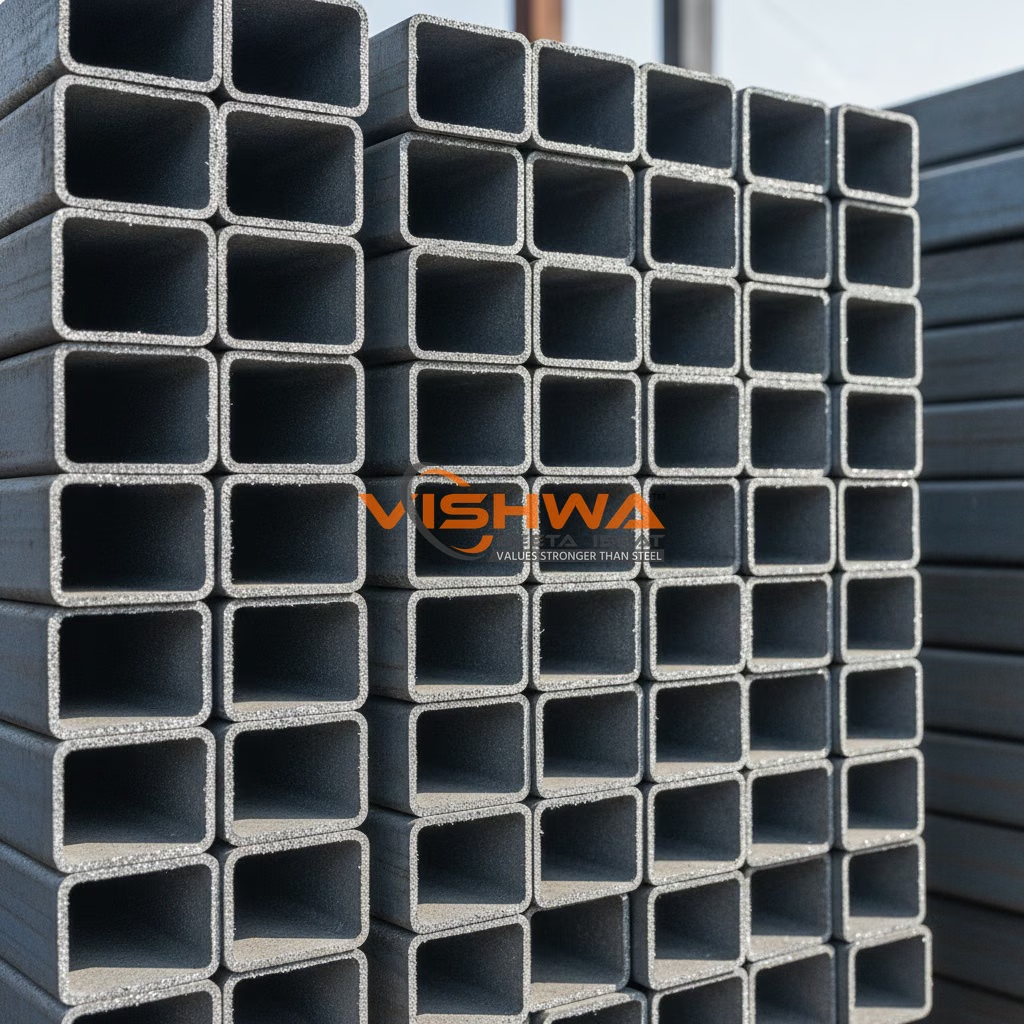
Rectangular hollow sections in different sizes. Measure the sides and wall thickness to find the weight in the chart.
This MS rectangular pipe weight chart lists the theoretical weight in kg per metre for the common rectangular hollow section (RHS) sizes, from 40x20 mm up to 200x100 mm, in wall thicknesses from 1.6 mm to 4.8 mm. The quick formula is: weight (kg/m) = [A x B - (A - 2t) x (B - 2t)] x 0.00785, where A and B are the outer sides and t is the wall thickness, all in millimetres. For example, a 50x25 mm pipe with a 2 mm wall weighs about 2.23 kg per metre, and a 100x50 mm pipe with a 3.2 mm wall weighs about 7.21 kg per metre. The full chart, the method and a site check are below.
MS Rectangular Pipe Weight Chart (kg per metre)
All weights are worked out from the outer size and wall thickness using a steel density of 7,850 kg/m³. They treat the corners as sharp, so they are theoretical figures. Real cold-formed pipes have rounded corners and are rolled within the tolerances of IS 4923, so a mill's printed weight can differ slightly (usually by a few percent). A dash means the size and thickness combination is not a common one.
| Size (mm) | 1.6 mm | 2.0 mm | 2.6 mm | 3.2 mm | 4.0 mm | 4.8 mm |
|---|---|---|---|---|---|---|
| 40 x 20 | 1.43 | 1.76 | 2.24 | 2.69 | - | - |
| 50 x 25 | 1.80 | 2.23 | 2.85 | 3.45 | 4.21 | - |
| 60 x 40 | 2.43 | 3.01 | 3.87 | 4.70 | 5.78 | 6.81 |
| 66 x 33 | 2.41 | 2.98 | 3.83 | 4.65 | 5.71 | 6.74 |
| 80 x 40 | 2.93 | 3.64 | 4.69 | 5.71 | 7.03 | 8.32 |
| 96 x 48 | 3.54 | 4.40 | 5.67 | 6.91 | 8.54 | 10.13 |
| 100 x 50 | 3.69 | 4.58 | 5.91 | 7.21 | 8.92 | 10.58 |
| 120 x 60 | 4.44 | 5.53 | 7.14 | 8.72 | 10.80 | 12.84 |
| 122 x 61 | 4.52 | 5.62 | 7.26 | 8.87 | 10.99 | 13.07 |
| 120 x 80 | 4.94 | 6.15 | 7.95 | 9.73 | 12.06 | 14.35 |
| 145 x 82 | - | 7.00 | 9.05 | 11.08 | 13.75 | 16.38 |
| 150 x 100 | - | 7.72 | 9.99 | 12.24 | 15.20 | 18.12 |
| 172 x 92 | - | - | 10.56 | 12.94 | 16.08 | 19.17 |
| 200 x 100 | - | - | 12.03 | 14.75 | 18.34 | 21.88 |
Not every size is rolled in every thickness by every mill. If you need a size that is not in the chart, use the formula below, or send us the size on WhatsApp and we will tell you what is in stock.
MS Rectangular Pipe Weight Formula
A rectangular pipe is a solid rectangle with a smaller rectangle taken out of the middle. So the steel area is the outer area minus the inner area, and the weight is that area multiplied by the density of steel.
- Steel area (mm²) = A x B - (A - 2t) x (B - 2t)
- Weight (kg/m) = steel area x 0.00785
The 0.00785 factor is simply 7,850 kg/m³ converted so that an area in mm² gives a weight in kg for each metre of length.
A shorter version that gives the same answer is:
- Weight (kg/m) = (2 x (A + B) - 4t) x t x 0.00785
Here (2 x (A + B) - 4t) is the length of the wall measured along its centre line, and multiplying by t gives the steel area.
Worked example: 80x40 mm pipe, 3.2 mm wall
- Outer area = 80 x 40 = 3,200 mm²
- Inner size = (80 - 6.4) x (40 - 6.4) = 73.6 x 33.6 = 2,472.96 mm²
- Steel area = 3,200 - 2,472.96 = 727.04 mm²
- Weight = 727.04 x 0.00785 = about 5.71 kg per metre
For a 6 m length, that is 5.71 x 6 = about 34.2 kg.
Converting to weight per foot
One metre is about 3.281 feet. Divide the kg/m figure by 3.281 to get kg per foot. A 100x50 mm pipe at 3.2 mm (7.21 kg/m) is about 2.20 kg per foot.
Weight of a 6 m Length (Common Sizes)
Rectangular hollow sections are usually sold in 6 metre lengths, and many buyers count pieces rather than metres. This table multiplies the chart value by 6.
| Size x thickness (mm) | Weight per metre (kg) | Weight per 6 m length (kg) | Approx. 6 m pieces per tonne |
|---|---|---|---|
| 40 x 20 x 1.6 | 1.43 | 8.6 | 116 |
| 50 x 25 x 2.0 | 2.23 | 13.4 | 74 |
| 60 x 40 x 2.0 | 3.01 | 18.1 | 55 |
| 80 x 40 x 2.6 | 4.69 | 28.1 | 35 |
| 100 x 50 x 3.2 | 7.21 | 43.3 | 23 |
| 120 x 80 x 4.0 | 12.06 | 72.4 | 13 |
| 150 x 100 x 4.8 | 18.12 | 108.7 | 9 |
Pieces per tonne are rounded down to whole lengths. Use them for a first estimate only. Your bill should always be based on the weighbridge weight.
Rectangular vs Square Pipe: Which Weighs More?
For the same wall thickness, weight depends only on the perimeter. A 60x40 mm rectangular pipe has the same perimeter as a 50x50 mm square pipe (200 mm), so at the same thickness they weigh almost the same. What changes is stiffness. A rectangular pipe is stronger when it bends across its deeper side, which is why it is used upright for purlins, gate frames and joists. For square sizes and their weights, see our MS square pipe weight per meter guide.
Grades and Standard for MS Rectangular Pipes
In India, cold-formed square and rectangular hollow sections for structural use are made to IS 4923. Common grades are YST 210, YST 240 and YST 310, and some mills also offer YST 355. The number is the minimum yield strength in MPa. The grade does not change the weight, because the density of mild steel stays the same. It changes how much load a given size can carry.
- YST 210: general fabrication, railings, furniture and light frames.
- YST 240 / YST 310: sheds, roof trusses, purlins and structural frames.
- YST 355: where the designer wants a lighter section for the same load.
Always follow the grade written in your structural drawing. Ask for the mill test certificate with every lot.
Where MS Rectangular Pipes Are Used
- Roof purlins and trusses in industrial sheds and warehouses
- Gates, grills, railings and boundary frames
- Mezzanine floors and support frames for deck sheet
- Solar panel mounting structures
- Truck bodies, trailers and machine frames
- Furniture, display racks and signboard frames
How to Check Rectangular Pipe Weight on Site
- Measure both outer sides with a tape or vernier, and the wall thickness at a cut end with a vernier.
- Find the size in the chart above, or work it out with the formula.
- Weigh a few full lengths, or weigh the whole lot on a weighbridge, and divide by the total length.
- Compare with the chart. A small difference is normal because of rounded corners and rolling tolerance. A large, repeated shortfall usually means a thinner wall than ordered.
Thinner-than-ordered walls are the most common problem with hollow sections. A pipe sold as 2.0 mm that is really 1.8 mm is about 10 percent lighter and weaker. Checking the weight is the fastest way to catch it. You can also use our rate and weight calculator or read the MS pipe weight calculator guide for round pipes.
Frequently Asked Questions
What is the formula for MS rectangular pipe weight?
Weight in kg per metre = [A x B - (A - 2t) x (B - 2t)] x 0.00785, where A and B are the outer sides and t is the wall thickness, all in mm. It is the steel area multiplied by the density of steel, 7,850 kg/m³.
What is the weight of a 100x50 MS rectangular pipe?
It depends on the wall thickness. In theory a 100x50 mm pipe weighs about 4.58 kg/m at 2.0 mm, 5.91 kg/m at 2.6 mm, 7.21 kg/m at 3.2 mm and 8.92 kg/m at 4.0 mm.
What is the weight of a 50x25 MS rectangular pipe?
A 50x25 mm pipe weighs about 1.80 kg/m at 1.6 mm, 2.23 kg/m at 2.0 mm and 2.85 kg/m at 2.6 mm. A 6 m length at 2.0 mm is about 13.4 kg.
Why is the real weight different from the chart?
The chart uses sharp corners and exact thickness. Real cold-formed pipes have rounded corners and are rolled within a tolerance, so the actual weight can be slightly lower or higher. A big gap usually means the wall is thinner than ordered.
Which IS code covers MS rectangular pipes?
IS 4923 covers cold-formed hollow steel sections (square and rectangular) for structural use. Common grades are YST 210, YST 240 and YST 310.
Are rectangular pipes sold by weight or by length?
Both quotes are common, but the bill for a bulk order is normally based on the weighbridge weight. Use the chart to convert between pieces and kilograms before you order.
Send us the sizes, wall thickness and quantity. Vishwa Geeta Ispat will reply with stock and today's delivered rate, billed on a weighbridge.