Steel Roofing Sheet: Types, Thickness, Weight and Buying Guide
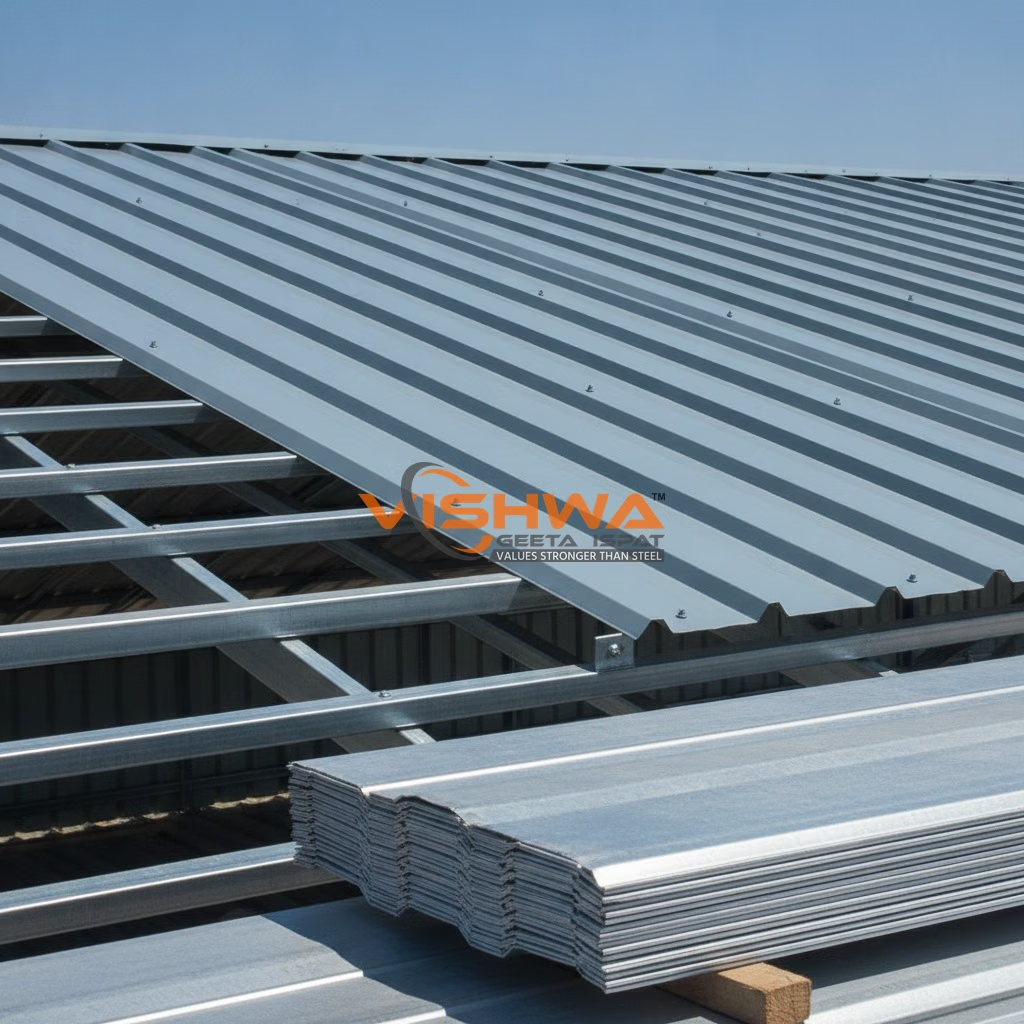
Colour-coated trapezoidal steel roofing sheets on an industrial shed, with plain galvalume sheets ready to fix.
A steel roofing sheet is a thin cold-rolled steel sheet with a metallic coating against rust, either zinc (GI) or aluminium-zinc (galvalume), and often a factory-baked paint layer on top (colour-coated, PPGI or PPGL). It is then rolled into a corrugated or trapezoidal profile so it is stiff enough to span between purlins. For most Indian homes, sheds and factories the choice comes down to three things: the coating (what stops rust), the base metal thickness (what gives strength), and the profile (how far the sheet can span and how well it drains). This guide explains each one in plain terms, shows how to work out sheet weight, and lists what to check on delivery so you get the sheet you paid for.
Types of Steel Roofing Sheet
All steel roofing sheets start as a thin steel coil. What changes is the coating on that coil and whether it is painted.
1. GI (galvanised iron) roofing sheet
Steel coated with zinc by hot-dip galvanising. The zinc protects the steel even where it is scratched, because zinc corrodes first. Plain GI corrugated sheets are the traditional low-cost roof for sheds, farm buildings, site offices and temporary structures. The usual weak point is the cut edge and the zinc slowly wearing away in wet or polluted air, so the life of a GI roof depends a lot on the zinc coating mass you buy.
2. Galvalume (aluminium-zinc) roofing sheet
Steel coated with an alloy of roughly 55% aluminium and 45% zinc with a little silicon, sold under names such as galvalume or zincalume and marked as AZ coating. The aluminium forms a tough barrier layer and the zinc gives cut-edge protection. For the same coating mass, galvalume generally lasts longer than plain zinc in most Indian climates, which is why it is now the usual base for good-quality roofing.
3. Colour-coated roofing sheet (PPGI / PPGL)
A GI base (PPGI = pre-painted galvanised iron) or galvalume base (PPGL = pre-painted galvalume) that has been primed and painted on a continuous coil-coating line before profiling. The paint adds a second barrier against rust, gives the colour, and can reflect more sun to keep the building cooler. Topcoats range from regular polyester (RMP/SMP) for general use to higher-durability paints such as PVDF for harsh or coastal sites. Colour-coated trapezoidal sheets are the standard roof and wall cladding for warehouses, factories and pre-engineered buildings. See our profile sheet range for colour-coated and galvalume options.
4. Insulated (PUF) steel roofing panels
Two steel sheets with a foam core in between. They cost more but cut heat gain and rain noise a lot, and are used for cold storage, clean rooms and comfortable workspaces. We cover these separately in our PUF sheet roofing guide.
| Type | Coating | Painted? | Typical use |
|---|---|---|---|
| GI sheet | Zinc (Z) | No | Sheds, farm buildings, temporary roofs |
| Galvalume sheet | Aluminium-zinc (AZ) | No | Industrial roofs, long-life budget roofing |
| PPGI sheet | Zinc + paint | Yes | Homes, shops, light industrial |
| PPGL sheet | Aluminium-zinc + paint | Yes | Factories, warehouses, PEB, coastal sites (with suitable paint) |
| PUF panel | Steel skins + foam core | Yes | Cold storage, insulated roofs |
Corrugated vs Trapezoidal Profile
The profile is the wave or rib shape rolled into the sheet. It has nothing to do with rust protection but a lot to do with strength and drainage.
- Corrugated (sine wave): rounded, shallow waves. Cheap and simple, common on GI sheets for small sheds. Shallow waves carry less water, so they need a steeper roof slope and closer purlins.
- Trapezoidal (box rib): deeper, flat-topped ribs with pans in between. Stiffer for the same thickness, so the sheet can span further and work on flatter roofs. This is the standard profile for colour-coated industrial roofing and wall cladding.
The profile also decides the cover width. A sheet rolled from a wide coil ends up narrower after profiling, and one rib is lost to the side overlap with the next sheet. So always compare quotes on the effective cover width, not the coil width. A low-priced sheet with a narrower cover width can need more sheets for the same roof.
Steel deck sheets look similar but are a different product: they are thicker and act as permanent shuttering for concrete floor slabs, not as a roof cover.
Thickness: BMT vs TCT
Roofing sheet thickness is the most common source of confusion and disputes. There are two numbers:
- BMT (base metal thickness): the thickness of the steel alone, without coating or paint. This is what gives the sheet its strength.
- TCT (total coated thickness): BMT plus the metallic coating plus the paint layers. This is what a micrometer reads on the finished sheet.
TCT is always more than BMT. A quote that says "0.50 mm" without saying BMT or TCT can mean two quite different sheets. Ask for the thickness in BMT, and get it written on the quotation and the invoice.
Which thickness to choose
Roofing sheets are commonly sold from about 0.30 mm up to 0.60 mm BMT, with thicker gauges available for special jobs. As a general guide:
| BMT (mm) | Where it is usually used |
|---|---|
| 0.30 - 0.35 | Small sheds, light temporary covers, low-wind sites with close purlins |
| 0.40 - 0.45 | Homes, shops, light roofs and wall cladding |
| 0.50 | Most factory and warehouse roofs; a safe default for industrial work |
| 0.55 - 0.60 | Longer purlin spacing, high-wind or exposed sites, heavy-duty roofs |
The right thickness depends on purlin spacing, wind exposure and the profile. Use the sheet maker's load-span table for the exact profile, or have your structural engineer confirm it. A thicker sheet on wrong purlin spacing can still fail, and a well-supported thinner sheet can perform fine.
Coating Grade: Z and AZ Numbers
The coating mass is written as a code with a number, in grams per square metre counted on both sides together:
- Z (zinc): for example Z120 or Z275 means about 120 g/m² or 275 g/m² of zinc in total.
- AZ (aluminium-zinc): for example AZ70, AZ100 or AZ150 means about 70, 100 or 150 g/m² of aluminium-zinc alloy in total.
More coating means longer life before rust starts, especially at cut edges, screw holes and scratches. For a long-life roof, a higher AZ grade on a galvalume base is the usual choice; very low coating masses are a common way to cut price that only shows up years later as early rust. Always ask what coating grade is in the quote, because two sheets of the same thickness and colour can carry very different coating.
Indian Standards (BIS) for Steel Roofing Sheets
Coated roofing steel in India is made to Bureau of Indian Standards codes, and many of these products are covered by BIS quality control orders, so the coil should carry ISI marking from a licensed producer. The main codes are:
| Product | Indian Standard |
|---|---|
| Hot-dip galvanised (zinc) sheet and coil, plain and corrugated | IS 277 |
| Hot-dip aluminium-zinc (galvalume) coated sheet and coil | IS 15961 |
| Pre-painted (colour-coated) galvanised sheet and coil | IS 14246 |
| Pre-painted aluminium-zinc coated sheet and coil | IS 15965 |
Ask for the mill test certificate (MTC) with each lot. It should show the grade, BMT, coating mass and, for painted sheets, the paint system. Our guide on deck sheet quality checks covers the same habit of matching paperwork to material.
Steel Roofing Sheet Weight per Square Metre
Sheet weight matters for transport, handling, the load on your roof structure and for checking that you received full thickness. You can work it out from the standard steel density of 7,850 kg/m³:
Steel weight (kg/m²) = BMT (mm) × 7.85
Add coating: coating mass in g/m² ÷ 1000. For example AZ150 adds 0.150 kg/m² and Z275 adds 0.275 kg/m². Paint adds a little more.
The table below is calculated with this formula for the flat steel before profiling. It is a guide for checking, not a mill figure.
| BMT (mm) | Steel only (kg/m²) | With AZ150 (kg/m²) | With Z275 (kg/m²) |
|---|---|---|---|
| 0.35 | 2.75 | 2.90 | 3.02 |
| 0.40 | 3.14 | 3.29 | 3.42 |
| 0.45 | 3.53 | 3.68 | 3.81 |
| 0.50 | 3.93 | 4.08 | 4.20 |
| 0.55 | 4.32 | 4.47 | 4.59 |
| 0.60 | 4.71 | 4.86 | 4.99 |
Worked example
Say a profiled sheet is rolled from a 1,220 mm wide coil of 0.50 mm BMT galvalume (AZ150), and the sheet is 3 m long:
- Flat area = 1.22 m × 3 m = 3.66 m²
- Weight = 3.66 × 4.08 ≈ 14.9 kg per sheet (plus a little for paint if colour-coated)
If that profile has a cover width of, for example, 1,050 mm, the same sheet covers 1.05 × 3 = 3.15 m² of roof, so the weight per square metre of roof covered is about 14.9 ÷ 3.15 ≈ 4.7 kg. The cover width here is only an example; use the actual figure for the profile you buy. For flat plate and sheet in any size, our MS plate weight calculator uses the same 7.85 rule.
A sheet that weighs clearly less than the formula suggests for its stated BMT is a sign that the steel is thinner than quoted. Weighing a bundle on a weighbridge and comparing it with the calculated weight is one of the simplest checks a buyer can do.
Sizes and Lengths
Roofing sheets are profiled from coil, so length is flexible:
- Standard lengths such as 8, 10, 12 and 20 feet are stocked for small jobs and retail.
- Cut-to-length sheets are rolled to the exact rafter length for industrial jobs, which avoids end laps (a common leak point). Very long sheets are limited mainly by transport and handling.
- Width depends on the coil width and profile. Compare the effective cover width between suppliers.
Accessories matter as much as the sheet: ridge caps, flashings, gutters, closure fillers and self-drilling screws with EPDM sealing washers. Leaks almost always start at fixings, laps and flashings rather than in the sheet itself.
Installation Basics That Decide How Long a Roof Lasts
- Slope: give the roof enough fall for the profile so water never sits on it. Shallow corrugated sheets need more slope than deep trapezoidal ribs; the maker's minimum slope for the profile is the figure to follow.
- Purlin spacing: match it to the sheet thickness and profile from the load-span table, with closer spacing at edges and ridge where wind uplift is highest.
- Laps: side-lap so the overlap faces away from the prevailing wind and rain; end laps on low slopes need sealant tape.
- Fixing: use self-drilling screws with sealing washers through the crest of the rib on roofs (not the pan where water runs), tightened just enough to seal without crushing the washer.
- Swarf: sweep off drilling and cutting chips the same day. Hot steel filings rust on the surface and stain or damage the coating.
- Dissimilar metals: avoid direct contact with copper, lead or wet treated timber, and avoid water draining from copper onto steel sheet.
How to Buy Steel Roofing Sheets Without Getting Short-Changed
- Get the full spec in writing: base (GI or galvalume), BMT, coating grade (Z or AZ number), paint system and colour, profile name and cover width, and length.
- Compare price per square metre covered, not per sheet or per running foot, so different cover widths and thicknesses are compared fairly.
- Check marking and paperwork: ISI mark and producer details printed on the sheet back or edge, and an MTC that matches the invoice.
- Measure on delivery: check thickness with a micrometer (remember it reads TCT), count sheets, measure lengths, and weigh the lot against the formula above.
- Inspect the surface: no white rust, dents, peeling paint or colour mismatch between bundles. Store bundles off the ground, under cover and slightly sloped so water cannot collect between sheets.
Roofing prices move with coil prices, coating grade, paint system and thickness, so any old price list is quickly out of date. For today's rate on your exact spec, message us on WhatsApp or check our live steel rates. You can also see our GC sheet page for plain galvanised corrugated sheets.
Frequently Asked Questions
Which steel roofing sheet is best for a house?
For most homes, a colour-coated galvalume (PPGL) trapezoidal sheet of about 0.45 to 0.50 mm BMT is a good balance of life, looks and cost. Add a PUF panel or an insulation layer if heat and rain noise are a concern.
What is the difference between GI and galvalume roofing sheets?
GI sheets are coated with zinc only. Galvalume sheets are coated with an aluminium-zinc alloy, which usually gives longer life for the same coating mass. Both can be supplied plain or colour-coated.
What does BMT mean on a roofing sheet?
BMT is base metal thickness: the steel only, without coating or paint. TCT (total coated thickness) includes the coating and paint and is always higher. Always buy on BMT.
How do I calculate the weight of a steel roofing sheet?
Multiply BMT in mm by 7.85 to get steel weight in kg per square metre, add the coating mass (for example 0.150 kg/m² for AZ150), then multiply by the flat sheet area. A 0.50 mm BMT AZ150 sheet weighs about 4.08 kg per flat square metre.
Which IS code applies to colour-coated roofing sheets?
Pre-painted galvanised sheets are made to IS 14246 and pre-painted galvalume sheets to IS 15965. The unpainted bases are covered by IS 277 (zinc) and IS 15961 (aluminium-zinc).
What does AZ150 mean?
AZ150 means an aluminium-zinc coating of about 150 grams per square metre, counted on both sides of the sheet together. A higher number means more coating and longer protection.
Need steel roofing sheets?
Vishwa Geeta Ispat supplies colour-coated, galvalume and GI roofing sheets with mill test certificates and weighbridge-verified dispatch. Send us your BMT, coating, colour, profile and lengths for a written quote.