Weld Mesh Weight Calculator: Formula, kg/m² Chart and SWG Table
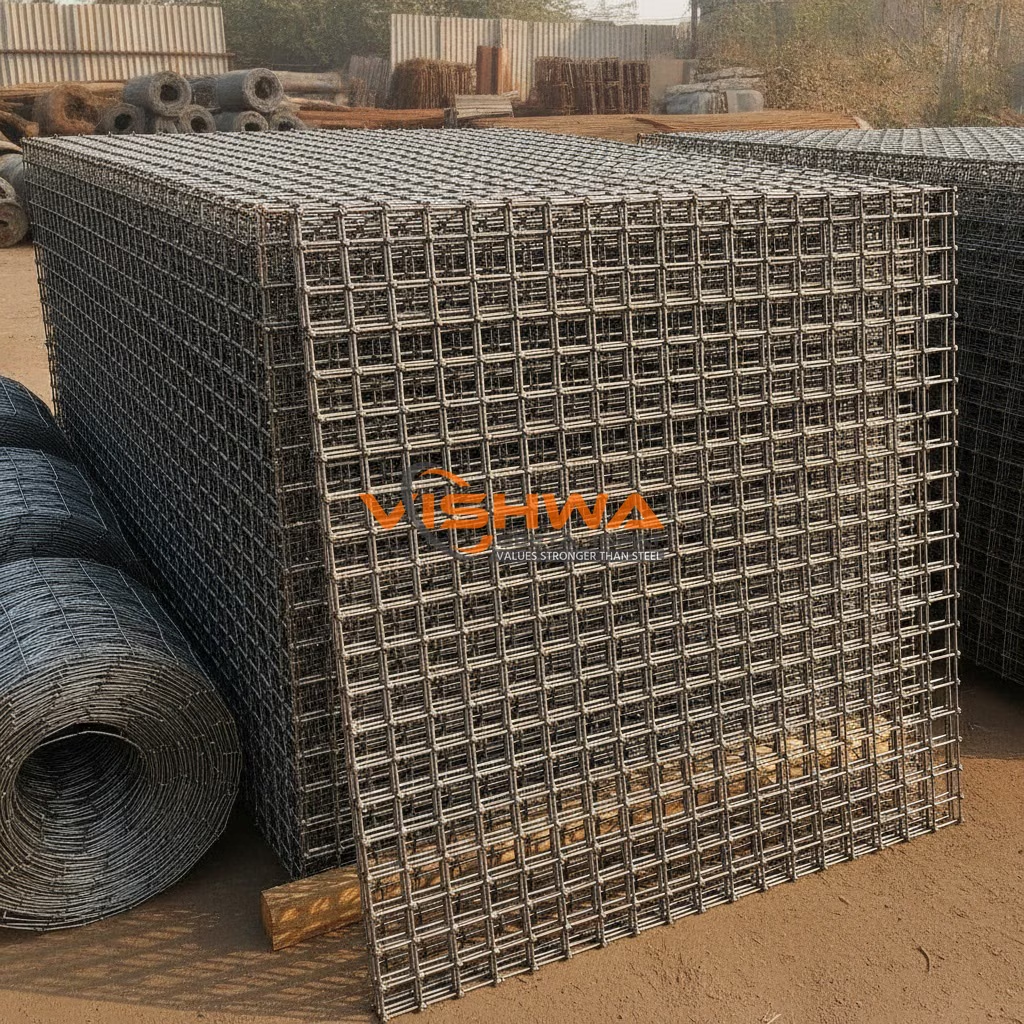
Square weld mesh panels: weight depends on wire diameter and wire spacing.
A weld mesh weight calculator works out how many kilograms of steel wire are in one square metre of welded mesh, using just two inputs: the wire diameter and the spacing between wires. For square mesh made from mild steel wire, the weight is 12.33 × d² ÷ p kg/m², where d is the wire diameter in mm and p is the centre-to-centre spacing in mm. For example, 3 mm wire at 50 × 50 mm spacing weighs about 2.22 kg per square metre. Multiply by the area of your panel or roll and you have the total weight, which is what weld mesh is usually priced and dispatched on. This guide explains the formula step by step, gives a ready chart, converts SWG gauges to mm, and shows worked examples for panels and rolls.
How Weld Mesh Weight Is Calculated
Weld mesh is simply two sets of straight wires laid at right angles and welded where they cross. So its weight is the weight of all the wire in one square metre. That needs three facts.
Step 1: Weight of one metre of wire
Mild steel has a density of about 7,850 kg/m³. A round wire of diameter d mm therefore weighs:
Wire weight (kg/m) = 0.006165 × d²
This is the same rule used for round bars and TMT bars (often written as d² ÷ 162). A 3 mm wire weighs 0.006165 × 9 = 0.0555 kg per metre.
Step 2: Metres of wire in one square metre
If wires run every p mm, there are 1,000 ÷ p wires across each metre. Each is one metre long inside a 1 m × 1 m square, so one direction holds 1,000 ÷ p metres of wire. Mesh has wires in two directions, so you add both.
Step 3: Put it together
Weight (kg/m²) = 6.165 × d² × (1 ÷ p1 + 1 ÷ p2)
where p1 and p2 are the spacings in the two directions (mm). For square mesh, p1 = p2 = p, and the formula becomes:
Weight (kg/m²) = 12.33 × d² ÷ p
The weld points add a tiny amount of metal and the overlap at panel edges varies, so treat the answer as a close theoretical figure. Your weighbridge slip is the final word on what was actually delivered.
Opening size or centre-to-centre spacing?
This is the most common mistake. The formula needs the pitch, the distance from the centre of one wire to the centre of the next. Some suppliers quote the clear opening (the gap between wires) instead. If your mesh size is a clear opening, add one wire diameter to it before using the formula. For a 50 mm clear opening with 3 mm wire, use p = 53 mm, which gives 2.09 kg/m² instead of 2.22 kg/m². Always ask which one the quotation means.
Weld Mesh Weight Chart (kg per m²)
The chart below uses the square-mesh formula with mild steel at 7,850 kg/m³ and spacing measured centre to centre. Values are theoretical and rounded to two decimals.
| Wire diameter | 25 × 25 mm | 50 × 50 mm | 75 × 75 mm | 100 × 100 mm |
|---|---|---|---|---|
| 2.0 mm | 1.97 | 0.99 | 0.66 | 0.49 |
| 2.5 mm | 3.08 | 1.54 | 1.03 | 0.77 |
| 3.0 mm | 4.44 | 2.22 | 1.48 | 1.11 |
| 4.0 mm | 7.89 | 3.95 | 2.63 | 1.97 |
| 5.0 mm | 12.33 | 6.17 | 4.11 | 3.08 |
Two patterns are worth remembering. Doubling the spacing halves the weight. Going from 2 mm to 4 mm wire makes the mesh four times heavier, because weight rises with the square of the diameter. So a small change in wire size changes cost far more than a change in spacing.
SWG to mm and Wire Weight per Metre
Weld mesh in India is often sold by SWG (Standard Wire Gauge). A higher gauge number means a thinner wire. Convert the gauge to mm first, then use the formula.
| SWG | Diameter (mm) | Wire weight (kg/m) |
|---|---|---|
| 6 | 4.877 | 0.1466 |
| 8 | 4.064 | 0.1018 |
| 10 | 3.251 | 0.0652 |
| 12 | 2.642 | 0.0430 |
| 14 | 2.032 | 0.0255 |
| 16 | 1.626 | 0.0163 |
| 18 | 1.219 | 0.0092 |
Note that SWG and AWG (American Wire Gauge) are different scales. A 16 SWG wire is 1.626 mm, while 16 AWG is about 1.29 mm, so check which gauge a quotation uses.
Worked Examples
Example 1: Square mesh panel
4 mm wire, 100 × 100 mm centre-to-centre, panel 8 ft × 4 ft (2.438 m × 1.219 m).
- Weight per m² = 12.33 × 4² ÷ 100 = 1.97 kg/m²
- Panel area = 2.438 × 1.219 = 2.97 m²
- Panel weight = 1.97 × 2.97 ≈ 5.87 kg
Example 2: Rectangular fencing mesh
3 mm wire, 50 × 100 mm spacing.
- Weight per m² = 6.165 × 3² × (1 ÷ 50 + 1 ÷ 100) = 6.165 × 9 × 0.03 ≈ 1.66 kg/m²
Example 3: Roll of mesh
2.5 mm wire, 50 × 50 mm, roll 1.2 m wide × 30 m long.
- Weight per m² = 12.33 × 2.5² ÷ 50 = 1.54 kg/m²
- Roll area = 1.2 × 30 = 36 m²
- Roll weight = 1.54 × 36 ≈ 55.5 kg
Things That Change the Real Weight
- Galvanising or PVC coating. A zinc coating (GI weld mesh) or a PVC layer adds weight on top of the steel figure. Ask whether a quoted kg/m² is for bare wire or the finished, coated mesh.
- Edge wires and selvedge. Panels may have heavier edge wires or extra wire beyond the last crossing, which adds a little.
- Diameter tolerance on wire. Drawn wire can be slightly under or over its nominal size. Because weight goes with d², even a small shortfall in diameter means noticeably less steel.
- Material. Stainless steel is a little denser than mild steel, so its weight comes out a few per cent higher for the same size.
Standards and Buying Checks
In India, welded mesh for general uses such as fencing, grills and guards is covered by IS 4948, and hard-drawn welded wire fabric for concrete reinforcement by IS 1566. When you buy:
- Get the wire diameter in mm (or SWG), the spacing and whether it is centre-to-centre or clear opening, the panel or roll size and the finish written on the quotation.
- Check a few wires with a vernier or micrometer on delivery. A slightly thinner wire is the easiest way to cut weight.
- Weigh a sample panel or roll and compare it with the calculated figure. A large shortfall points to thinner wire or wider spacing than ordered.
- Pull at a few weld points by hand. Welds should not snap or come loose easily.
- Compare rates on a per-kg basis, not only per panel or per roll, so different sizes can be judged fairly.
For other wire products, see our barbed wire weight per meter chart and the binding wire gauge and weight guide. You can also browse our weld mesh range or use the steel weight and freight calculator for other sections.
Frequently Asked Questions
What is the formula for weld mesh weight?
For square mild steel weld mesh, weight in kg/m² = 12.33 × d² ÷ p, where d is the wire diameter in mm and p is the centre-to-centre spacing in mm. For rectangular mesh, use 6.165 × d² × (1 ÷ p1 + 1 ÷ p2).
What is the weight of 3 mm 50 × 50 weld mesh per square metre?
About 2.22 kg/m² if the 50 mm is measured centre to centre. If 50 mm is the clear opening, the pitch is 53 mm and the weight is about 2.09 kg/m².
How do I calculate the weight of a weld mesh roll?
Work out the weight per square metre, then multiply by the roll width times its length. A 1.2 m × 30 m roll of 2.5 mm wire at 50 × 50 mm weighs about 1.54 × 36 = 55.5 kg.
Which gauge is 3 mm weld mesh?
The closest SWG size is 10 SWG, which is 3.251 mm. 11 SWG is 2.946 mm, so a "3 mm" wire falls between the two. Always confirm the actual diameter in mm.
Does galvanised weld mesh weigh more?
Yes. The zinc coating adds weight on top of the steel wire, and a PVC coating adds more. The formula gives the bare steel weight, so ask your supplier whether a quoted weight includes the coating.
Which IS code covers weld mesh?
IS 4948 covers welded steel wire mesh for general uses such as fencing and grills. IS 1566 covers hard-drawn steel wire fabric used to reinforce concrete.
Need weld mesh?
Vishwa Geeta Ispat supplies MS and GI weld mesh in panels and rolls with weighbridge-verified dispatch. Send us the wire size, spacing, sheet or roll size and quantity for a written quote.