Steel Quantity Calculation for Slab, Beam, Column and Footing: Thumb Rules, Formula and Worked Example
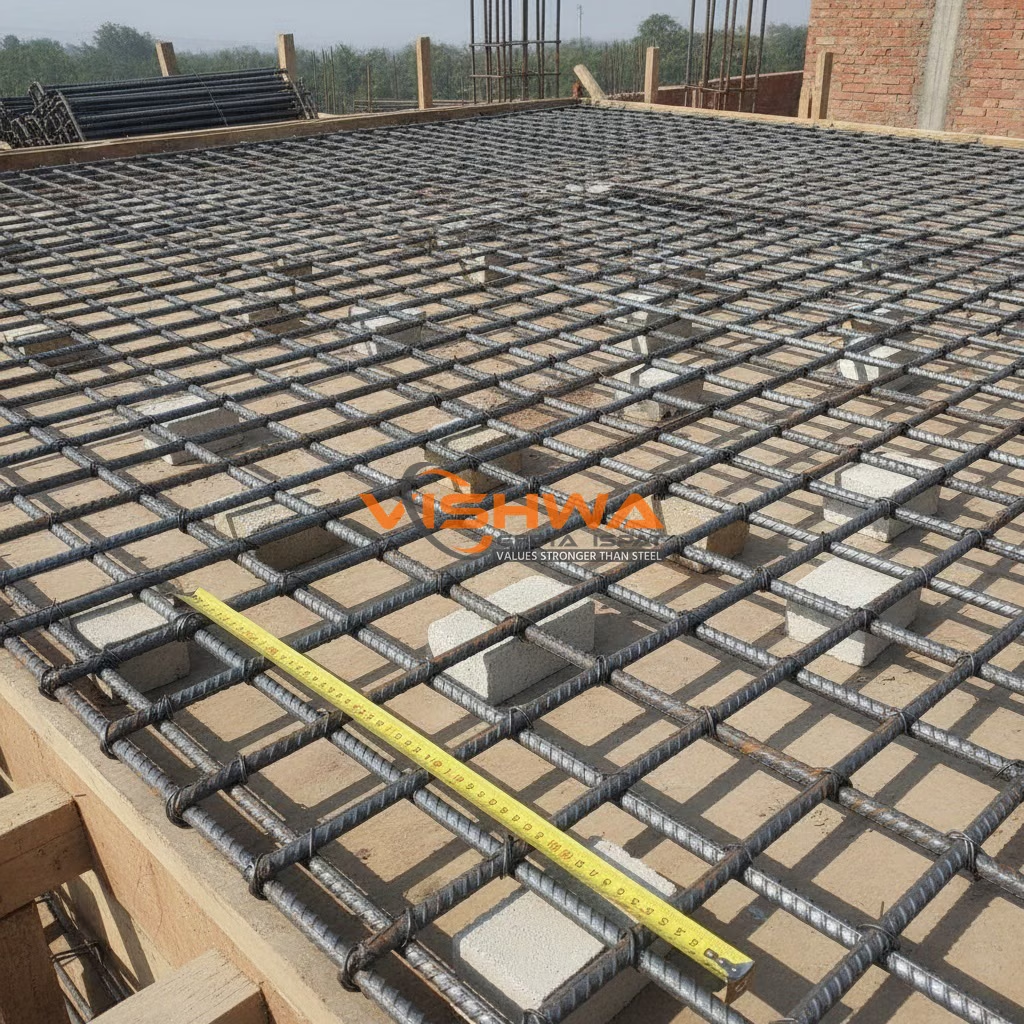
Slab reinforcement on site. Count bars and lengths from the drawing for an exact steel quantity.
Steel quantity calculation can be done three ways, from rough to exact. For a quick budget, estimating guides use a thumb rule of roughly 3.5 to 5.5 kg of steel per sq ft of built-up area for a typical house. For a single RCC element, multiply its concrete volume by a steel percentage and by the density of steel (7,850 kg/m³). For an exact order list, count every bar from the drawing, find its length and multiply by its weight per metre using D²/162. This guide explains all three methods, works through a slab example step by step, and shows how to turn the final kg figure into TMT bars you can actually order.
Three Ways to Calculate Steel Quantity
| Method | What you need | Accuracy | Best used for |
|---|---|---|---|
| Thumb rule per sq ft | Built-up area only | Rough (can be off by 20 to 30 percent) | Early budget, comparing quotes for a whole house |
| Percentage of concrete volume | Size of each slab, beam, column, footing | Medium | Element-wise estimate before drawings are final |
| Bar bending schedule (BBS) | Structural drawing with bar sizes and spacing | Exact (plus wastage) | Final order, billing and site checking |
Only the BBS method uses your actual design. The other two are planning tools, so always confirm the final figure against the structural drawing made by your engineer.
Method 1: Thumb Rule for Steel per Square Foot
The simplest thumb rule for steel links steel to the built-up area of the building. Published estimating guides do not agree on one number, but most fall in these bands:
| Type of building | Steel per sq ft of built-up area (typical range) | Steel for 1,000 sq ft |
|---|---|---|
| Residential house, G+1 or G+2 | 3.5 to 5.5 kg | 3.5 to 5.5 tonnes |
| Commercial or heavier framed building | 5.0 to 7.5 kg | 5.0 to 7.5 tonnes |
The spread is wide because steel depends on span, number of floors, soil, seismic zone and the designer's choices. A house with long open spans or a weak soil needs more steel than one with short, regular rooms. Use the lower end only for simple, regular plans and the upper end for anything with cantilevers, long spans or extra floors planned later.
Method 2: Steel as a Percentage of Concrete Volume
This method works element by element. The formula is:
Steel weight (kg) = concrete volume (m³) x steel percentage / 100 x 7,850
Because steel weighs 7,850 kg per m³, every 1 percent of steel equals about 78.5 kg of steel per m³ of concrete. The table below shows the ranges commonly used for planning, converted to kg per m³.
| RCC element | Typical steel range (% of concrete volume) | Approx. kg of steel per m³ of concrete |
|---|---|---|
| Slab | 0.7 to 1.0% | 55 to 80 (guides quote up to 100 including laps and extra top bars) |
| Beam | 1.0 to 2.0% | 80 to 160 |
| Column | 1.0 to 2.5% | 80 to 200 |
| Footing | 0.8 to 1.0% | 60 to 80 |
IS 456:2000 sets the limits designers work within. For example, column main bars must be at least 0.8 percent and not more than 6 percent of the column's cross-section (4 percent is the practical upper limit). The real figure for your building comes from the design, not from this table.
Quick example
A beam 230 mm wide, 450 mm deep and 4 m long holds 0.23 x 0.45 x 4 = 0.414 m³ of concrete. At 1.5 percent steel: 0.414 x 1.5 / 100 x 7,850 = about 48.7 kg of steel.
Method 3: Exact Steel Quantity Calculation with the D²/162 Formula
For an order list, you calculate every bar. The key formula gives the weight of one metre of round steel bar:
Weight per metre (kg/m) = D² / 162, where D is the bar diameter in mm.
It comes from the steel density: 7,850 kg/m³ x (π / 4) x D² / 1,000,000 = D² / 162.2. The same formula is behind our TMT bar weight chart.
| Bar diameter | Weight per metre (kg/m) | Weight of one 12 m bar (kg) |
|---|---|---|
| 8 mm | 0.395 | 4.74 |
| 10 mm | 0.617 | 7.40 |
| 12 mm | 0.888 | 10.66 |
| 16 mm | 1.580 | 18.96 |
| 20 mm | 2.470 | 29.64 |
| 25 mm | 3.850 | 46.20 |
Steps to calculate steel from a drawing
- Count the bars. Number of bars = (length to be covered − 2 x cover) / spacing, rounded up, plus 1.
- Find the cutting length of one bar. Clear length − 2 x cover, plus hooks, bends, cranks and laps shown in the drawing.
- Total length = number of bars x cutting length.
- Weight = total length x D² / 162.
- Repeat for every bar mark (main bars, distribution bars, stirrups, extra top bars) and add them up.
- Add wastage of about 3 to 5 percent for cutting ends and offcuts.
Worked Example: Steel Quantity for a Slab
Take a simple slab 4 m x 3 m and 125 mm thick, with 20 mm clear cover. The drawing shows main bars of 10 mm at 150 mm spacing running across the 3 m span, and distribution bars of 8 mm at 200 mm spacing running along the 4 m side. To keep the arithmetic clear, the bars are taken as straight, without hooks or cranks.
| Step | Main bars (10 mm @ 150) | Distribution bars (8 mm @ 200) |
|---|---|---|
| Number of bars | (4,000 − 40) / 150 = 26.4, round up to 27, + 1 = 28 | (3,000 − 40) / 200 = 14.8, round up to 15, + 1 = 16 |
| Length of one bar | 3,000 − 40 = 2.96 m | 4,000 − 40 = 3.96 m |
| Total length | 28 x 2.96 = 82.88 m | 16 x 3.96 = 63.36 m |
| Weight per metre | 10² / 162 = 0.617 kg/m | 8² / 162 = 0.395 kg/m |
| Weight | 82.88 x 0.617 = 51.1 kg | 63.36 x 0.395 = 25.0 kg |
Total = 51.1 + 25.0 = 76.1 kg. Adding 5 percent wastage gives about 80 kg.
Now compare with the thumb rule. The slab holds 4 x 3 x 0.125 = 1.5 m³ of concrete, so 76.1 kg works out to about 51 kg per m³, or 0.65 percent. That is below the 80 to 100 kg/m³ some guides quote, and the reason is useful to know: a real slab also has cranked bars, extra top bars over supports and laps, which this simplified example leaves out. This is exactly why a thumb rule is fine for a budget but the BBS is what you should order from.
Don't Forget Binding Wire and Wastage
- Binding wire: estimating guides commonly allow about 8 to 10 kg of binding wire per tonne of reinforcement. See our binding wire buying guide for gauges and coil sizes.
- Wastage: 3 to 5 percent is a common allowance. Planning cutting lengths from full 12 m bars keeps offcuts low.
- Chairs and spacers: small extra bars that hold top steel at the right height are easy to miss in an estimate. Check whether your drawing lists them.
From Kilograms to an Order: Converting Steel Quantity into TMT Bars
TMT bars are sold and billed by weight, but they arrive as 12 m bars, so it helps to convert your total into bar counts per diameter. Divide the kg needed for each size by the weight of one 12 m bar from the table above. For the slab example: 51.1 kg of 10 mm is about 6.9 bars, so order 7; 25.0 kg of 8 mm is about 5.3 bars, so order 6.
Keep in mind that bars are rolled within a weight tolerance allowed by IS 1786, so a bundle can weigh slightly more or less than the theoretical figure. Bulk orders are billed on the weighbridge weight, so always ask for the weighbridge slip. Our rate and weight calculator does the kg-to-bar conversion for you, and the TMT bar landed cost guide explains how GST and freight add to the final bill.
Common Mistakes in Steel Quantity Estimation
- Using a thumb rule as the final order. It can leave you short on site or with unused tonnes.
- Forgetting the +1 bar when counting bars across a span.
- Ignoring laps. Long bars joined on site need a lap length, which adds real weight in columns and long beams.
- Mixing units. Keep all lengths in metres for the weight step, and all bar diameters in mm inside D²/162.
- Not checking delivered weight. Compare the weighbridge slip with your calculated total before you pay.
Frequently Asked Questions
What is the thumb rule for steel in a house?
Estimating guides commonly quote about 3.5 to 5.5 kg of steel per sq ft of built-up area for a residential building, so roughly 3.5 to 5.5 tonnes for 1,000 sq ft. It is a budgeting figure only; the exact quantity comes from the structural drawing.
How do you calculate steel quantity in a slab?
Count the main and distribution bars from their spacing, multiply each count by the bar's cutting length, then multiply the total length by D²/162 to get kg. Add 3 to 5 percent for wastage. For a rough check, multiply the slab's concrete volume by about 55 to 100 kg per m³.
What is the D²/162 formula?
It gives the weight of one metre of round steel bar in kg, where D is the diameter in mm. For example, a 12 mm bar weighs 12 x 12 / 162 = 0.888 kg per metre. It comes from the density of steel, 7,850 kg/m³.
How much steel is needed per cubic metre of concrete?
It depends on the element. Planning ranges are about 55 to 100 kg per m³ for slabs, 80 to 160 kg for beams, 80 to 200 kg for columns and 60 to 80 kg for footings. Every 1 percent of steel equals about 78.5 kg per m³.
How much wastage should I add to steel quantity?
A common allowance is 3 to 5 percent for cutting ends and offcuts. Careful planning of cutting lengths from 12 m bars can keep it at the lower end.
How much binding wire is needed per tonne of steel?
Estimating guides usually allow about 8 to 10 kg of binding wire per tonne of reinforcement steel. The exact amount depends on bar spacing and how many joints are tied.
Send us the bar sizes and kg (or your BBS) on WhatsApp. Vishwa Geeta Ispat will reply with today's delivered rate for TMT bars and binding wire, billed on weighbridge weight.