TMT Bar Weight Chart: Weight Per Metre, Per Foot and Per 12 m Bar (6mm to 40mm)
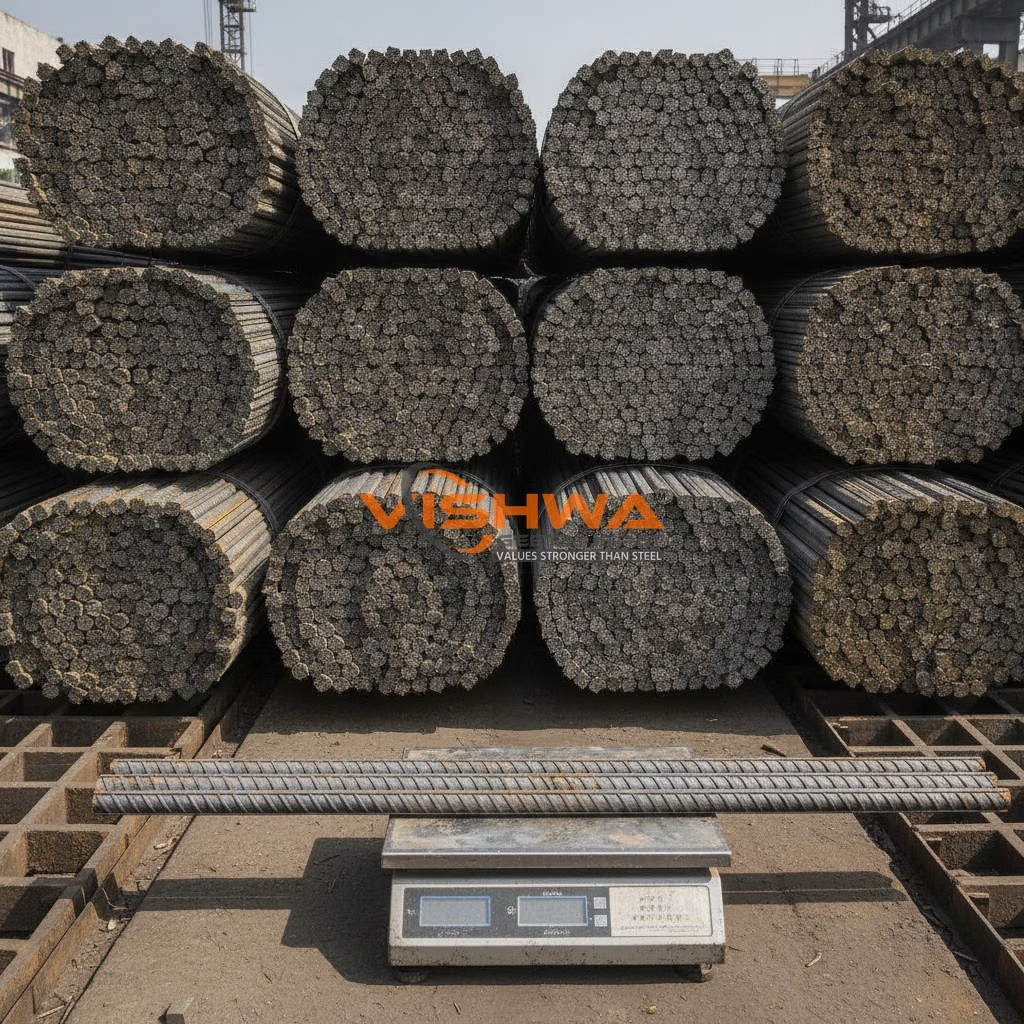
Weighing a TMT bar on site is the quickest way to compare it with the weight chart.
This TMT bar weight chart gives the theoretical weight of every common TMT bar size from 6mm to 40mm. The quick rule is simple: weight in kg per metre = D² / 162, where D is the bar diameter in millimetres. So a 12mm bar weighs about 0.89 kg per metre and about 10.7 kg for a standard 12 m length, while a 16mm bar weighs about 1.58 kg per metre and about 19 kg per 12 m bar. The full chart, the formula behind it and a simple site check are below.
TMT Bar Weight Chart (Per Metre, Per Foot and Per 12 m Bar)
All values below are calculated with the D²/162 formula, which assumes a steel density of 7,850 kg/m³. They are theoretical (nominal) weights, rounded. Real bars can be a little lighter or heavier within the rolling tolerance allowed by IS 1786.
| Bar size (mm) | Weight per metre (kg) | Weight per foot (kg) | Weight per 12 m bar (kg) | Approx. 12 m bars per tonne |
|---|---|---|---|---|
| 6mm | 0.222 | 0.068 | 2.67 | 375 |
| 8mm | 0.395 | 0.120 | 4.74 | 210 |
| 10mm | 0.617 | 0.188 | 7.41 | 135 |
| 12mm | 0.889 | 0.271 | 10.67 | 93 |
| 16mm | 1.580 | 0.482 | 18.96 | 52 |
| 20mm | 2.469 | 0.753 | 29.63 | 33 |
| 25mm | 3.858 | 1.176 | 46.30 | 21 |
| 28mm | 4.840 | 1.475 | 58.07 | 17 |
| 32mm | 6.321 | 1.927 | 75.85 | 13 |
| 36mm | 8.000 | 2.438 | 96.00 | 10 |
| 40mm | 9.877 | 3.010 | 118.52 | 8 |
You will often see the 12mm figure written as 0.888 kg/m. That is the same number cut off at three decimals instead of rounded. Either is fine for estimating. "Bars per tonne" is rounded down to whole bars, so a tonne of 12mm steel gives roughly 93 full 12 m bars.
The TMT Bar Weight Formula: Where D²/162 Comes From
The formula is not a trade secret or a brand rule. It is plain geometry multiplied by the density of steel:
- Cross-section area of a round bar = π × D² / 4 (in mm²).
- Volume of 1 metre of bar = area × 1,000 mm, which you convert to cubic metres by multiplying by 10-9.
- Weight = volume × 7,850 kg/m³ (the standard density of steel).
Put together, that gives D² × 0.006165 kg per metre. Since 1 ÷ 0.006165 is about 162.2, engineers round it to the easy-to-remember D² / 162. If you work in feet, multiply the per-metre answer by 0.3048, or use D² / 533 to get kg per foot directly.
Worked example: 12mm bar
12 × 12 = 144. Then 144 ÷ 162 = 0.889 kg per metre. For a 12 m bar: 0.889 × 12 = 10.67 kg. For a 40-foot length (about 12.19 m) you would get roughly 10.8 kg.
Cross-section area by size
Engineers use the area, not the weight, to check how much steel a beam or column needs. It is handy to keep both together:
| Bar size (mm) | Cross-section area (mm²) |
|---|---|
| 6mm | 28.3 |
| 8mm | 50.3 |
| 10mm | 78.5 |
| 12mm | 113.1 |
| 16mm | 201.1 |
| 20mm | 314.2 |
| 25mm | 490.9 |
| 28mm | 615.8 |
| 32mm | 804.2 |
| 36mm | 1,017.9 |
| 40mm | 1,256.6 |
For more on this calculation, see our guide to the area of a rod.
How to Use the Chart to Estimate Steel for Your Site
Your structural drawing or bar bending schedule lists each bar mark with its diameter, cut length and number of pieces. To turn that into kilograms:
- Multiply the cut length by the number of pieces to get total running metres for each size.
- Multiply the running metres by the weight per metre from the chart.
- Add up all sizes, then add a small allowance for laps, bends and cutting waste as advised by your engineer.
Example: 40 bars of 12mm, each 6 m long = 240 running metres. 240 × 0.889 = about 213 kg. Add 60 bars of 8mm stirrups at 1.2 m each = 72 m × 0.395 = about 28 kg. Total for these two marks is roughly 242 kg before allowances.
If you would rather not do the maths by hand, our rate and weight calculator works it out for you.
Which TMT Bar Size Is Used Where?
The bar size on a job is always set by the structural engineer. As a general picture of how sizes are typically used in Indian construction:
| Bar size | Typical uses |
|---|---|
| 6mm - 8mm | Stirrups and rings in beams and columns, light slab work, boundary walls |
| 10mm - 12mm | Slabs, lintels, small beams and columns in houses |
| 16mm - 20mm | Main bars in beams and columns, footings for multi-storey buildings |
| 25mm - 32mm | Heavy columns, rafts, commercial and industrial structures |
| 36mm - 40mm | Bridges, flyovers, dams and other heavy infrastructure |
Theoretical Weight vs Actual Weight
The chart gives the theoretical weight. Bars that come off a rolling mill are never exactly the nominal diameter, so their real weight is a little different. IS 1786, the Indian standard for TMT bars, allows a mass tolerance that depends on the bar diameter and on whether you are checking a single bar or a whole batch. A bar inside that tolerance is fully compliant.
What matters for a buyer is that bars which are consistently well below the chart weight are a warning sign. Underweight bars mean less steel in your structure and you pay for kilograms you did not receive. Always ask for the mill test certificate (MTC) for the heat number on your bundle tag, and buy ISI-marked bars from a known brand.
Weighbridge weight or theoretical weight: know which one you are paying for
Steel is sold in India in two ways. Some suppliers bill on actual weight, measured on a weighbridge. Others bill on theoretical (sectional) weight, which is the number of bars multiplied by the chart weight. The two can differ by a few per cent on the same load. Neither is wrong, but you should know which basis your quote uses before you compare prices from two suppliers. At Vishwa Geeta Ispat, every order is billed by weighbridge weight with a GST invoice and weighbridge slip.
Quick Site Check: Is Your TMT Bar the Right Weight?
You do not need a lab to spot a badly underweight lot. A simple check on delivery:
- Pick a few bars of each size at random from different bundles.
- Measure each bar's length with a tape (or cut a clean 1 m sample).
- Weigh it on an accurate scale.
- Divide the weight by the length to get kg per metre.
- Compare with the chart. A small difference is normal. A large and repeated shortfall across bars should be raised with the supplier before the steel is used.
Also check the brand marking rolled onto the bar, the ISI mark and CML number on the tag, and that the heat number matches the MTC. Our guide on how to buy TMT bars online covers the full set of checks.
Does Grade Change the Weight? (Fe415, Fe500, Fe500D, Fe550D)
No. The grade tells you the strength of the steel, not its weight. A 12mm Fe500D bar and a 12mm Fe550D bar have the same theoretical weight per metre, because both are steel of the same diameter. What changes is how much load the bar can carry, which is why a higher grade can sometimes let your engineer use fewer or smaller bars. The same applies across brands: weight depends on diameter, not on the name on the tag.
Using Weight to Work Out Cost
Because TMT is priced per kg or per tonne, the chart is also your cost tool. Multiply the total weight from your estimate by the per-kg rate you are quoted, then add GST and freight to get the real landed cost. Rates move with the market, so do not rely on an old price list. See today's market direction on our live steel price trend page, read our TMT bar landed cost guide, or ask us on WhatsApp for today's delivered rate.
Frequently Asked Questions
What is the formula for TMT bar weight?
Weight in kg per metre = D² / 162, where D is the diameter in mm. It comes from the bar's cross-section area multiplied by the density of steel, 7,850 kg/m³.
What is the weight of a 12mm TMT bar?
A 12mm TMT bar weighs about 0.889 kg per metre (often written 0.888), so a standard 12 m bar weighs about 10.67 kg.
How many 12mm TMT bars are in one tonne?
About 93 full bars of 12 m length, since each 12 m bar weighs about 10.67 kg. For 8mm it is about 210 bars, and for 16mm about 52 bars.
What is the weight of a 16mm TMT bar per metre?
About 1.58 kg per metre, or roughly 18.96 kg for a 12 m bar.
Does Fe500D weigh more than Fe415 or Fe550D?
No. Bars of the same diameter have the same theoretical weight whatever the grade or brand. The grade only changes the strength of the steel.
Why is my TMT bar lighter than the chart weight?
Rolling mills cannot make bars at exactly the nominal diameter, so a small variation is normal and IS 1786 allows a tolerance. A large, repeated shortfall is a warning sign. Ask for the mill test certificate and check the ISI mark.
Send us your sizes and quantity, or your bar bending schedule. Vishwa Geeta Ispat will reply with today's delivered rate.