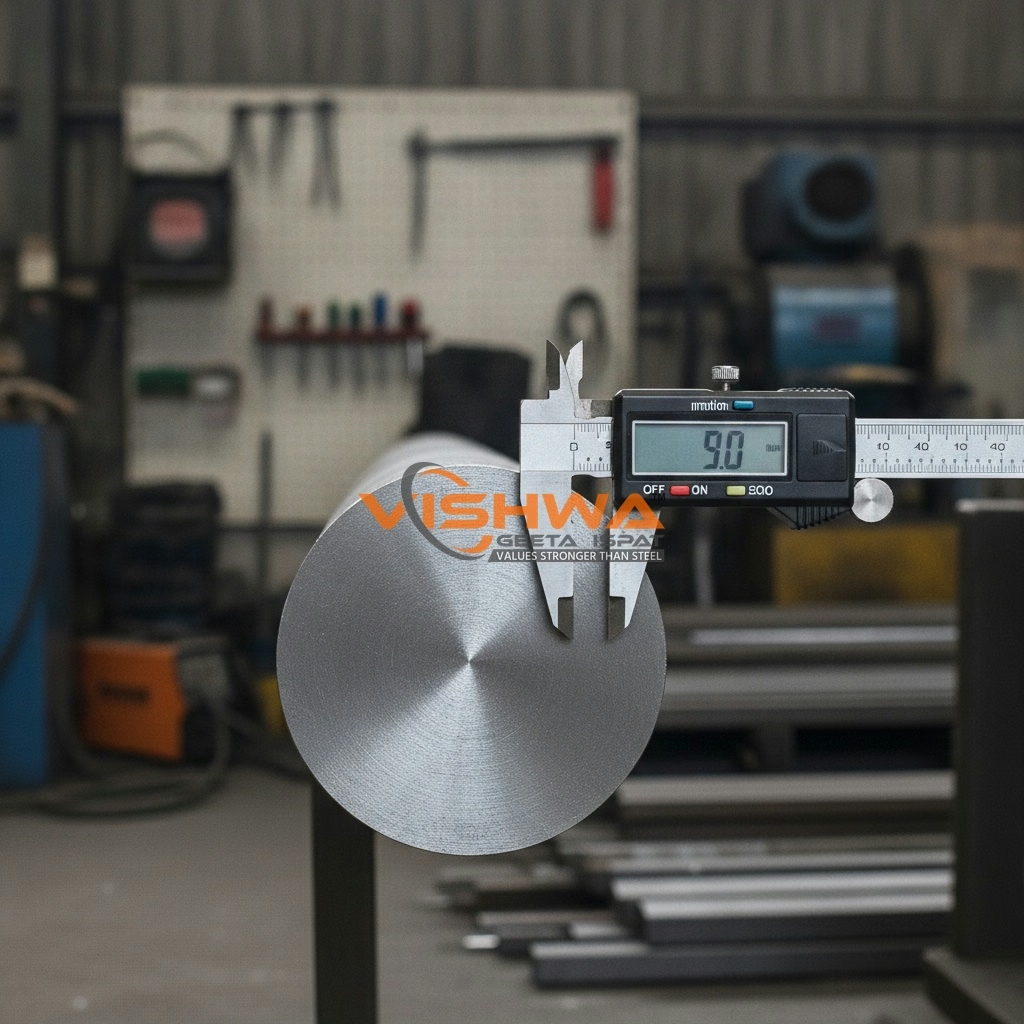
Area of a rod — cross-sectional formula reference.
Area of a Rod: Formula, Calculation & MS Round Bar Table
The area of a rod is its cross-sectional area — the circular face you'd see cutting straight across it. For any solid round rod: A = π × d² ÷ 4 = 0.7854 × d², where d is diameter in mm and A comes out in mm². This single formula drives weight estimation, billing, and structural calculations for MS round bar, TMT bar, and any cylindrical steel section.
Step-by-Step Calculation
- Measure the diameter with a vernier calliper across the widest point, perpendicular to the rod axis.
- Square the diameter. For d = 25mm → 25 × 25 = 625.
- Multiply by 0.7854 (which is π ÷ 4). 625 × 0.7854 = 490.87 mm².
- Convert units if needed. mm² ÷ 100 = cm²; mm² ÷ 1,000,000 = m².
Worked Examples
- 12mm rod: 0.7854 × 144 = 113.10 mm² (1.131 cm²)
- 20mm rod: 0.7854 × 400 = 314.16 mm² (3.142 cm²)
- 32mm rod: 0.7854 × 1024 = 804.25 mm² (8.043 cm²)
Common mistake: using A = πr² without halving the diameter first. If d = 20mm, r = 10mm — using 20 as the radius gives 4× the correct area. Using A = 0.7854 × d² directly avoids this error since you enter the diameter as-is.
MS Round Bar — Area & Weight Table
The table below covers standard MS round bar diameters from 8mm to 50mm.
| Dia (mm) | Area (mm²) | kg/m | kg — 6m bar |
|---|---|---|---|
| 8 | 50.27 | 0.395 | 2.37 |
| 10 | 78.54 | 0.617 | 3.70 |
| 12 | 113.10 | 0.888 | 5.33 |
| 16 | 201.06 | 1.579 | 9.47 |
| 20 | 314.16 | 2.466 | 14.80 |
| 25 | 490.87 | 3.853 | 23.12 |
| 32 | 804.25 | 6.313 | 37.88 |
| 40 | 1256.64 | 9.865 | 59.19 |
| 50 | 1963.50 | 15.413 | 92.48 |
Nominal values from A = 0.7854 × d²; actual weight subject to ±2.5% rolling tolerance per IS 1852.
From Area to Weight to Cost
Weight (kg/m) = d² ÷ 162 is the fast Indian-trade shortcut, accurate to within 0.5% of the exact formula. Example: 25mm rod → 625 ÷ 162 = 3.858 kg/m; a 6m bar weighs approximately 23.15 kg.
Accuracy matters at scale: measuring a 25mm rod as 26mm changes the area from 490.87 mm² to 530.93 mm² — an 8% overestimate. On a 10-tonne order, that error compounds directly into the billed weight, which is why suppliers provide Mill Test Certificates and large orders should be verified against weighbridge weight.
Other Cross-Section Shapes
| Shape | Formula | Notes |
|---|---|---|
| Solid round rod | A = 0.7854 × d² | MS round bar, TMT, shafts, axles |
| Hollow round (tube) | A = π(D² − d²) ÷ 4 | D = outer dia, d = inner dia — see the MS pipe weight chart |
| Square bar | A = s² | 25mm square = 625 mm², 27% more steel than 25mm round |
| Hexagonal rod | A = 0.866 × s² | s = across-flats; used for fastener stock |
Related Reading
Frequently Asked Questions
What is the formula for the area of a rod?
For a solid circular rod: A = π × d² ÷ 4 = 0.7854 × d², where d is diameter in mm and A is area in mm².
What is the cross-sectional area of a 16mm rod?
0.7854 × 256 = 201.06 mm² (2.011 cm²). Weight per metre is 1.579 kg/m — a standard reference for 16mm MS round bar and TMT.
How is the area of a rod used to calculate weight?
Weight (kg) = Area (cm²) × Length (cm) × 7.85 ÷ 1000. The trade shortcut is Weight (kg/m) = d² ÷ 162.
What is the area of a 25mm MS round bar?
0.7854 × 625 = 490.87 mm² (4.909 cm²). Weight per metre is 3.853 kg/m; a 6m bar weighs approximately 23.12 kg.
Why does a 1mm diameter measurement error matter for billing?
Because area scales with the square of diameter, small measurement errors compound — a 25mm rod measured as 26mm overstates area (and billed weight) by about 8%.
Share diameter, length, and quantity via the rate & weight calculator — Vishwa Geeta Ispat will confirm cross-sectional area, weight per metre, and current rate.