MS Bar Weight Calculation: Formulas and Weight Charts for Round, Square, Flat and Hex Bars
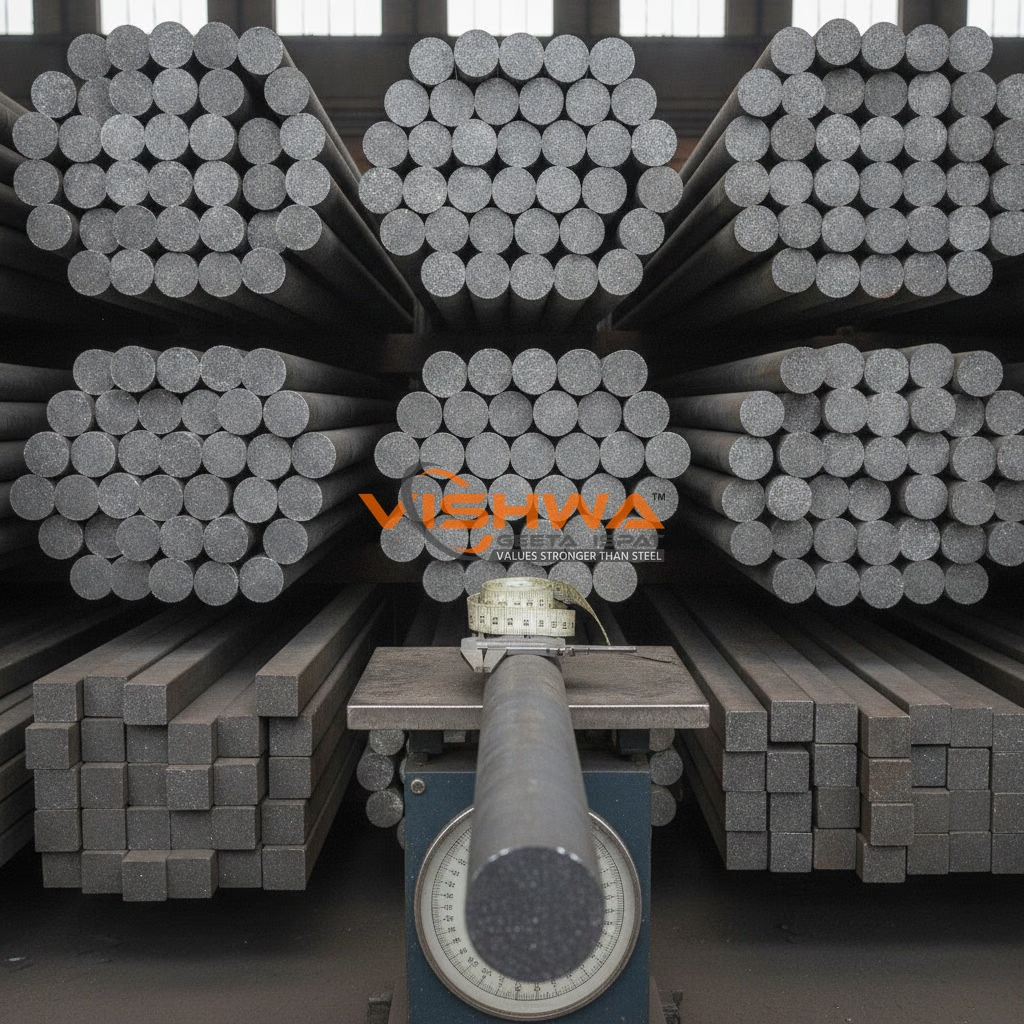
Plain MS round and square bars. Weight per metre depends only on shape and size.
MS bar weight calculation comes down to one idea: weight equals cross-section area times length times the density of mild steel, 7,850 kg/m³. With sizes in millimetres and length in metres, that gives four short formulas: a round bar weighs D²/162 kg per metre, a square bar weighs 0.00785 × side², a flat bar weighs 0.00785 × width × thickness, and a hexagon bar weighs 0.0068 × across-flats². Multiply the result by the bar length and the number of pieces to get total kg. Below you will find each formula explained, ready-made kg/m charts from 6 mm to 100 mm, worked examples and the checks to run when the steel arrives.
MS Bar Weight Formulas at a Glance
All four formulas use the same density, 7,850 kg/m³, which is the standard figure for mild (carbon) steel. Only the shape of the cross-section changes.
| Bar shape | Weight per metre (kg/m) | Short form | Size you measure |
|---|---|---|---|
| Round bar | 0.006165 × D² | D² / 162 | Diameter D in mm |
| Square bar | 0.00785 × S² | S² / 127.4 | Side S in mm |
| Flat bar | 0.00785 × W × T | W × T / 127.4 | Width W and thickness T in mm |
| Hexagon bar | 0.006798 × A² | about 0.0068 × A² | Across-flats A in mm |
For the total weight of a lot: kg = weight per metre × length of one bar (m) × number of bars.
Where the Formulas Come From
Weight is simply volume multiplied by density. For one metre of bar, the volume is the cross-section area times 1 m. Because the area is in mm² and density is in kg/m³, the units convert neatly: 1 mm² over 1 metre is 0.000001 m³, so 7,850 × 0.000001 = 0.00785 kg per mm² per metre. Every formula above is that number multiplied by the area of the shape.
Round bar: why D²/162
The area of a circle is π × D² / 4. Multiply by 0.00785 and you get 0.006165 × D². Dividing 1 by 0.006165 gives about 162.2, so site engineers round it to D²/162. For a full walk-through of the circle area step, see our guide on the area of a rod.
Square and flat bar: 0.00785
A square or rectangle has an area of side × side or width × thickness, so the constant 0.00785 is used directly. Dividing 1 by 0.00785 gives 127.4, which is why some charts write the square bar formula as S²/127.4.
Hexagon bar: 0.0068
A regular hexagon measured across its flats has an area of about 0.866 × A². Multiply by 0.00785 and the constant becomes 0.006798, usually rounded to 0.0068.
MS Round Bar Weight Chart (6 mm to 100 mm)
These are theoretical weights at 7,850 kg/m³, worked out from the exact constant 0.006165. A 6 m length is shown because it is a common cut length for round bars; ask for the length you actually need.
| Diameter (mm) | kg per metre | kg per foot | kg per 6 m bar |
|---|---|---|---|
| 6 | 0.222 | 0.068 | 1.33 |
| 8 | 0.395 | 0.120 | 2.37 |
| 10 | 0.617 | 0.188 | 3.70 |
| 12 | 0.888 | 0.271 | 5.33 |
| 16 | 1.578 | 0.481 | 9.47 |
| 20 | 2.466 | 0.752 | 14.80 |
| 25 | 3.853 | 1.175 | 23.12 |
| 28 | 4.834 | 1.473 | 29.00 |
| 32 | 6.313 | 1.924 | 37.88 |
| 36 | 7.990 | 2.435 | 47.94 |
| 40 | 9.865 | 3.007 | 59.19 |
| 45 | 12.485 | 3.805 | 74.91 |
| 50 | 15.413 | 4.698 | 92.48 |
| 56 | 19.335 | 5.893 | 116.01 |
| 63 | 24.470 | 7.459 | 146.82 |
| 65 | 26.049 | 7.940 | 156.29 |
| 70 | 30.210 | 9.208 | 181.26 |
| 75 | 34.680 | 10.571 | 208.08 |
| 80 | 39.458 | 12.027 | 236.75 |
| 90 | 49.940 | 15.222 | 299.64 |
| 100 | 61.654 | 18.792 | 369.92 |
If you use the rounded D²/162 instead, your answer will be a fraction of a percent higher (for example 0.889 kg/m for 12 mm instead of 0.888). That gap is far smaller than normal rolling tolerance, so either is fine for estimating.
MS Square Bar Weight Chart
| Side (mm) | kg per metre | kg per foot | kg per 6 m bar |
|---|---|---|---|
| 6 × 6 | 0.283 | 0.086 | 1.70 |
| 8 × 8 | 0.502 | 0.153 | 3.01 |
| 10 × 10 | 0.785 | 0.239 | 4.71 |
| 12 × 12 | 1.130 | 0.345 | 6.78 |
| 16 × 16 | 2.010 | 0.613 | 12.06 |
| 20 × 20 | 3.140 | 0.957 | 18.84 |
| 25 × 25 | 4.906 | 1.495 | 29.44 |
| 32 × 32 | 8.038 | 2.450 | 48.23 |
| 40 × 40 | 12.560 | 3.828 | 75.36 |
| 50 × 50 | 19.625 | 5.982 | 117.75 |
| 63 × 63 | 31.157 | 9.497 | 186.94 |
| 75 × 75 | 44.156 | 13.459 | 264.94 |
| 100 × 100 | 78.500 | 23.927 | 471.00 |
A square bar is always about 27 percent heavier than a round bar of the same size, because a square of side S has more area than a circle of diameter S. Do not swap one for the other in an estimate without recalculating. See our MS square bar page for the sections we supply.
MS Hexagon Bar Weight Chart
| Across flats (mm) | kg per metre | kg per 6 m bar |
|---|---|---|
| 10 | 0.680 | 4.08 |
| 12 | 0.979 | 5.87 |
| 16 | 1.740 | 10.44 |
| 20 | 2.719 | 16.32 |
| 25 | 4.249 | 25.49 |
| 32 | 6.961 | 41.77 |
| 40 | 10.877 | 65.26 |
| 50 | 16.996 | 101.97 |
Always measure a hexagon bar across two opposite flat faces, not across the corners. Measuring corner to corner gives a bigger number and will overstate the weight by about a third.
MS Flat Bar Weight
Flat bars come in many width and thickness combinations, so the formula is quicker than a chart: width (mm) × thickness (mm) × 0.00785 = kg per metre. A 50 × 6 mm flat, for example, weighs 50 × 6 × 0.00785 = 2.355 kg/m. For a full size-by-size table, see our MS flat weight chart.
Worked Examples
Example 1: A lot of round bars
You need 40 pieces of 32 mm round bar, each 5.5 m long.
- Weight per metre: 0.006165 × 32 × 32 = 6.313 kg/m
- Weight of one piece: 6.313 × 5.5 = 34.72 kg
- Total: 34.72 × 40 = about 1,389 kg (1.39 tonnes)
Example 2: Square bars for a gate frame
A fabricator needs 12 pieces of 25 × 25 mm square bar, 3 m each.
- Weight per metre: 0.00785 × 25 × 25 = 4.906 kg/m
- Total: 4.906 × 3 × 12 = about 176.6 kg
Example 3: How many bars in one tonne?
For 20 mm round bar in 6 m lengths: one bar weighs 2.466 × 6 = 14.80 kg, so 1,000 ÷ 14.80 = about 67 to 68 bars per tonne. Use this kind of reverse check to confirm a delivery count against the invoice weight.
MS Round Bar vs TMT Bar: Same Formula, Different Product
The D²/162 formula also works for TMT bars, because weight depends only on diameter and density, not on the surface ribs or the grade. But the products are different. An MS round bar is plain and smooth, commonly rolled from structural grades under IS 2062, and used for shafts, pins, bolts, gate and grill work, machine parts and general fabrication. A TMT bar has ribs for grip in concrete and is made to IS 1786 for reinforcement. If you are working out rebar for a slab or column, use our TMT bar weight chart and the steel quantity calculation guide instead.
Theoretical Weight vs Actual Weight
Every number on this page is a theoretical weight. Real bars vary slightly because hot rolling cannot hold an exact diameter along the whole length, and the standards allow a tolerance band. So a bundle on the weighbridge will rarely match the chart to the kilogram.
- Ask how you are billed. Some sellers bill on actual weighbridge weight, others on theoretical (section) weight. Know which one your quote uses before comparing rates.
- Spot-check the size. Measure a few bars with a vernier caliper at more than one point. A bar that is consistently under size will weigh less than the chart.
- Weigh a sample. Cut or pick one full-length bar, weigh it, divide by its length and compare with the kg/m in the chart.
- Check the mill test certificate. It should show the grade and the heat number, so you know the material matches what you ordered.
From Weight to Cost
Steel is priced per kg or per tonne, so the weight you calculate is the base of every quote. Multiply total kg by the rate per kg, then add cutting charges if any, freight and GST. MS bars are usually classed under HSN heading 7214 (bars and rods of non-alloy steel); confirm the exact code and GST on your invoice. Rates for round, square and hexagon bars change with the market and with size, so we do not publish fixed prices here. Message us on WhatsApp for today's rate, or check the live steel price trend for the market direction.
Frequently Asked Questions
What is the formula for MS bar weight calculation?
For a round bar, weight in kg per metre = D² / 162, where D is the diameter in mm. For a square bar use 0.00785 × side², for a flat bar 0.00785 × width × thickness, and for a hexagon bar 0.0068 × across-flats². Multiply by length in metres for the total.
What is the weight of a 12 mm MS round bar per metre?
About 0.888 kg per metre (12 × 12 / 162). A 6 m length weighs about 5.33 kg.
How do you calculate MS square bar weight?
Multiply the side in mm by itself and by 0.00785. A 20 × 20 mm square bar weighs 20 × 20 × 0.00785 = 3.14 kg per metre.
What density is used for mild steel weight?
7,850 kg per cubic metre (7.85 g/cm³). This is the standard value used in Indian weight tables and calculators for mild steel.
Why does my bar weigh less than the chart?
Chart weights are theoretical. Rolling tolerance means the actual diameter can be slightly under the nominal size, which lowers the weight. Measure the bar and weigh a sample to see how far it is from the chart.
Is MS round bar weight the same as TMT bar weight?
Yes, for the same diameter the theoretical weight is the same, because both use D²/162. The products differ in surface, standard and use: plain MS round bars for fabrication and machining, ribbed TMT bars for concrete reinforcement.
Send the bar shape, size, length and quantity on WhatsApp. Vishwa Geeta Ispat will reply with today's rate for MS round, square and flat bars, with delivery.