HR Coil Full Form: Hot Rolled Coil Meaning, Grades and Uses
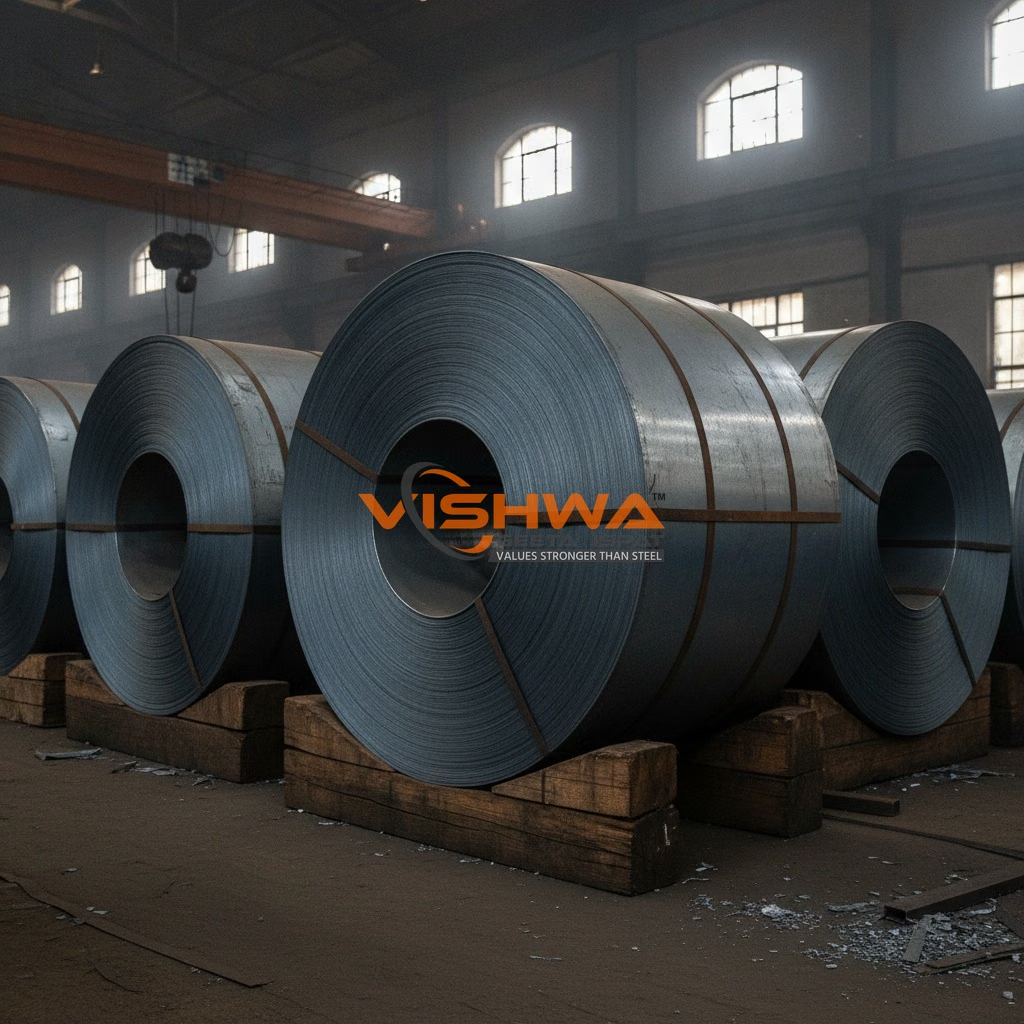
HR coil means Hot Rolled coil: steel strip rolled red-hot and wound into a roll.
The HR coil full form is Hot Rolled coil. It is a long strip of steel that has been rolled thin while red-hot, at a temperature above its recrystallisation point (roughly 900°C and higher), and then wound into a large roll. HR coil is the basic flat steel product in India. It is used as it is for structures and fabrication, and it is the starting material for MS plates, sheets, pipes, cold rolled (CR) coil and galvanised sheet. In steel market reports you will also see it written as HRC, short for Hot Rolled Coil.
What Does HR Coil Mean?
Break the term into its two parts:
- HR (Hot Rolled): the steel is passed through rolling mills while it is still hot enough to shape easily. Rolling it hot makes it possible to reduce a thick slab to a few millimetres in one continuous line.
- Coil: once the strip is thin enough, it is cooled with water sprays and wound into a tight roll so it can be stored, transported and later cut to size.
When a coil is cut into flat pieces, the product is sold as HR sheet (thinner) or HR plate (thicker). So HR coil, HR sheet and HR plate are the same steel in different forms. Our HR coil product page lists the forms we supply.
How HR Coil Is Made
The process at an integrated steel plant follows the same basic steps:
- Slab casting: liquid steel is cast into thick rectangular slabs.
- Reheating: the slabs are heated in a furnace until they are evenly hot right through.
- Roughing: heavy rolling stands squeeze the slab down to a thinner "transfer bar".
- Finishing: a line of finishing stands rolls the bar to its final thickness, still above the recrystallisation temperature.
- Cooling and coiling: the strip runs across a cooling table with water sprays and is wound into a coil.
Because the steel cools in open air, a thin dark-grey or bluish oxide layer called mill scale forms on the surface. The edges can be slightly rounded, and the thickness is held to a looser tolerance than cold rolled steel. For most structural and fabrication work, none of this matters.
HR Coil Grades and IS Standards in India
HR coil sold in India is made to Bureau of Indian Standards (BIS) codes. The standard depends on what the steel will be used for:
| Standard | What it covers | Typical use |
|---|---|---|
| IS 2062 | Hot rolled structural steel (plates, strips, sections) | Buildings, sheds, bridges, frames, general fabrication |
| IS 1079 | Hot rolled low carbon sheet and strip, from commercial to drawing quality | Pressed and bent parts, general engineering |
| IS 10748 | Hot rolled steel strip for welded tubes and pipes | ERW pipe and hollow section making |
| IS 5986 | Hot rolled flat steel for flanging and forming | Automotive chassis and frame parts |
What E250, E350 and BR Mean in IS 2062
Under IS 2062, the grade name tells you the strength. The number after "E" is the minimum yield stress in MPa (N/mm²) for thinner sections. The letter after it tells you the impact (toughness) testing done on the steel.
| IS 2062 grade | Min. yield stress (MPa)* | Min. tensile strength (MPa) | Common use |
|---|---|---|---|
| E250 | 250 | 410 | General structures, sheds, gates, fabrication |
| E350 | 350 | 490 | Heavier structures where higher strength saves weight |
| E410 | 410 | 540 | High-strength structural and engineering parts |
*Yield values are for thinner material (below 20 mm). Thicker sizes have slightly lower minimums. Always check the mill test certificate.
- A: no impact test required. Fine for ordinary, non-critical work.
- BR: impact tested at room temperature.
- B0: impact tested at 0°C.
- C: impact tested at minus 20°C, for cold conditions or dynamic loads.
So "E250 BR" means 250 MPa minimum yield, impact tested at room temperature. It is the most commonly ordered structural grade.
HR Coil Thickness, Width and Coil Weight
HR coil comes in a wide range of sizes. Thickness usually starts below 2 mm and goes up to about 20 to 25 mm, and widths commonly run from around 900 mm to 2,000 mm. A single coil often weighs well over 10 tonnes. The exact range depends on the mill, so confirm the available thickness and width before you place an order. You can also buy it cut to length as sheets or plates. Common cut sizes are 1250 x 2500 mm and 1500 x 6000 mm.
HR Sheet Weight Formula
Steel weighs 7.85 kg per square metre for every 1 mm of thickness. So:
Weight (kg) = Thickness (mm) x Width (m) x Length (m) x 7.85
| Thickness (mm) | Weight per m² (kg) | One 1250 x 2500 mm sheet (kg) |
|---|---|---|
| 1.6 | 12.56 | 39.25 |
| 2 | 15.70 | 49.06 |
| 2.5 | 19.63 | 61.33 |
| 3 | 23.55 | 73.59 |
| 4 | 31.40 | 98.13 |
| 5 | 39.25 | 122.66 |
| 6 | 47.10 | 147.19 |
| 8 | 62.80 | 196.25 |
| 10 | 78.50 | 245.31 |
| 12 | 94.20 | 294.38 |
These are theoretical weights. Actual weight changes slightly with the rolling tolerance. You can work out the length of steel in a coil the same way: Length (m) = Coil weight (kg) / (Thickness (mm) x Width (m) x 7.85). For example, a 20-tonne coil of 3 mm x 1250 mm holds roughly 680 metres of strip. For quick sums, use our MS plate weight calculator.
HR Coil vs CR Coil vs HRPO
Three related products often get confused. CR coil is made by rolling pickled HR coil again at room temperature. HRPO is HR coil that has only been cleaned.
| Point | HR coil | HRPO (Pickled and Oiled) | CR coil |
|---|---|---|---|
| Full form | Hot Rolled | Hot Rolled Pickled and Oiled | Cold Rolled |
| Surface | Dark grey, mill scale | Clean, scale removed by acid, light oil coat | Smooth, bright |
| Thickness tolerance | Wider | Same as HR | Tight |
| Typical thickness | Thicker gauges | Thicker gauges | Thin gauges |
| Cost | Lowest | Slightly higher | Higher |
| Best for | Structures, fabrication, pipes, plates | Parts that will be painted, pressed or welded cleanly | Appliances, furniture, car body panels |
A few other short forms you will meet on quotations: CRCA is Cold Rolled Close Annealed, GP is Galvanised Plain sheet, and GC is Galvanised Corrugated sheet. GP and GC are made by zinc-coating steel strip. See our steel roofing sheet guide for the roofing side.
Uses of HR Coil
- Construction and structures: base plates, gusset plates, purlins, sheds and pre-engineered buildings.
- Pipes and tubes: slit into strip and formed into ERW pipes and square or rectangular hollow sections.
- Fabrication: tanks, gates, grills, machine frames and trailer bodies.
- Automotive and agriculture: chassis members, wheels, tractor parts and implements.
- Raw material: feedstock for CR coil, galvanised sheet and chequered plate.
HSN Code and GST for HR Coil
Under the customs tariff, hot rolled flat products of non-alloy steel 600 mm wide or wider fall under HSN heading 7208. Narrower flat products (below 600 mm) come under heading 7211. Most iron and steel products currently attract 18% GST. Tax rules change, so confirm the full 8-digit code and rate with your accountant before you invoice. Our GST and landed cost guide shows how tax and freight add to the final price.
How to Buy HR Coil or Sheet: Quick Checklist
- Grade: state the standard and grade (for example IS 2062 E250 BR), not just "HR sheet".
- Size: give thickness, width and length, or coil weight if you are buying full coils.
- Finish: say whether you need plain HR, HRPO, or mill edge vs trimmed edge.
- Documents: ask for the mill test certificate (MTC) and a GST invoice for every lot.
- Weight: agree whether billing is on actual weighbridge weight or theoretical weight.
- Rate: HR coil prices move with the market every week, so always ask for a fresh written quote. Our article on why steel prices rise and fall explains the drivers.
Frequently Asked Questions
What is the full form of HR coil?
HR coil stands for Hot Rolled coil. It is steel strip rolled at high temperature, above its recrystallisation point, and then wound into a coil. Market reports often call it HRC.
What is the difference between HR coil and CR coil?
HR coil is rolled hot and has a dark, scaled surface with looser size tolerance. CR (Cold Rolled) coil is HR coil that has been pickled and rolled again at room temperature. That gives it a smooth, bright finish and tighter thickness, at a higher cost.
Which IS code is used for HR coil?
IS 2062 is the most common, for structural steel grades such as E250 and E350. IS 1079 covers general and drawing-quality hot rolled sheet, IS 10748 covers strip for pipes, and IS 5986 covers steel for forming and flanging.
What does E250 BR mean on HR sheet?
It is an IS 2062 grade. E250 means a minimum yield stress of 250 MPa, and BR means the steel is impact tested at room temperature. It is the standard choice for general structural work.
How do you calculate the weight of an HR sheet?
Multiply thickness in mm by width and length in metres, then by 7.85. For example, a 5 mm sheet of 1250 x 2500 mm weighs about 5 x 1.25 x 2.5 x 7.85 = 122.7 kg.
What is the HSN code of HR coil?
Hot rolled flat non-alloy steel 600 mm or wider falls under HSN heading 7208, and narrower strip under 7211. Confirm the exact 8-digit code and current GST rate with your accountant.
Need HR coil, sheet or plate in Raipur or Chhattisgarh?
Vishwa Geeta Ispat supplies HR coil, HR sheets and MS plates in IS 2062 grades, with mill test certificates and weighbridge-verified dispatch. Send us the grade, thickness, size and quantity on WhatsApp for today's rate and a written quote.